

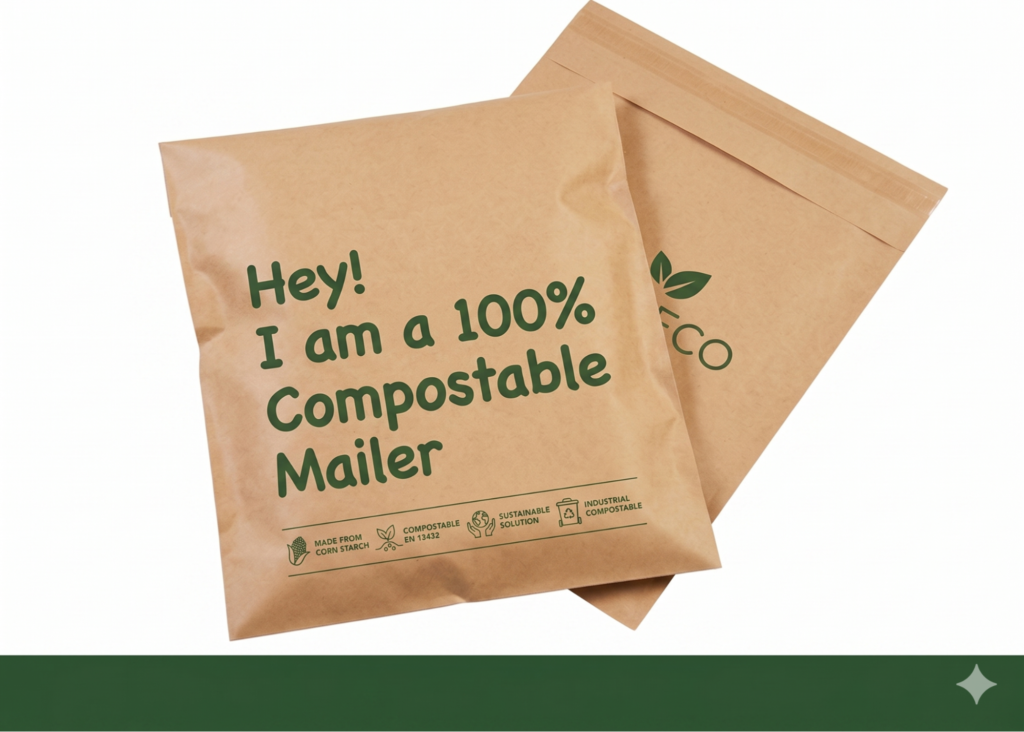
Most brands start with the wrong idea. They think sustainable e-commerce packaging means replacing plastic with paper.
That is not the real shift.
The real shift is moving from material choice to system design.
When we look at packaging at scale, what matters is not just what it is made of, but how it behaves across its full life cycle:
- How much material is used
- How efficiently it moves through logistics
- What happens after the customer throws it away
A practical way to understand sustainable e-commerce packaging is through four working principles:
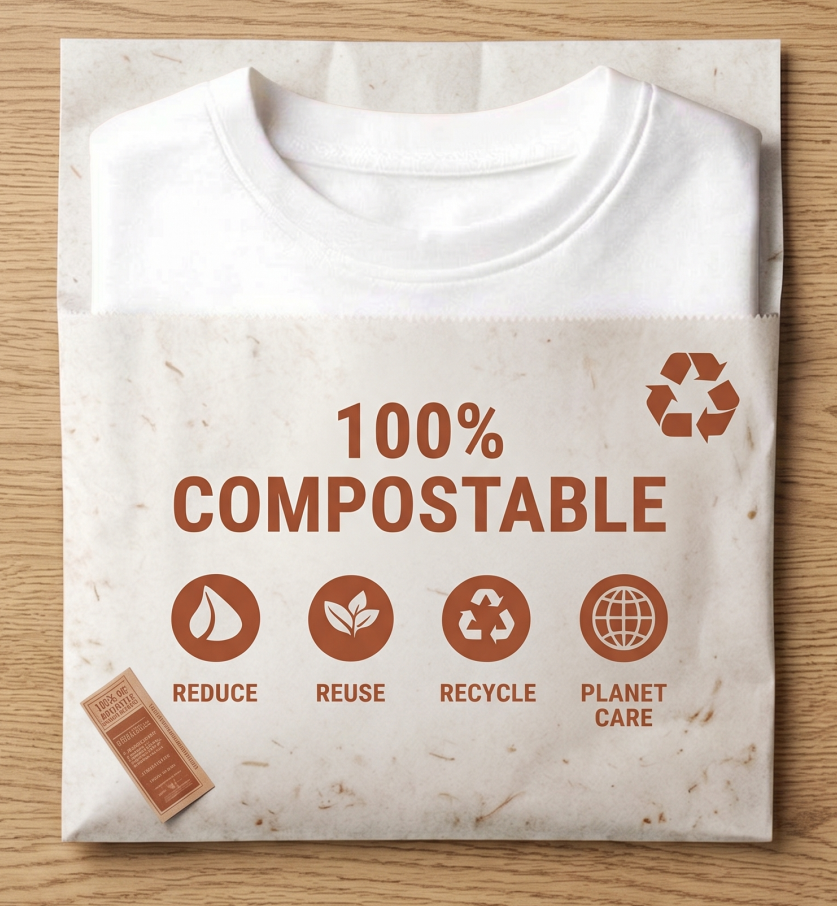
- Reduce: Use less material through right-sizing and eliminating unnecessary layers
- Reuse: Design packaging that can go through multiple cycles
- Recycle: Use formats that fit existing recycling systems
- Compost: Where recycling fails, use materials that safely break down
In other words, sustainability is not a swap. It is a balance.
And once you see it that way, the next question becomes obvious.
If this is the system, where is it breaking today?
Why Does E-commerce Packaging Need to Change?
Global e-commerce generated roughly 1.76 million tonnes of plastic packaging waste in 2022. That number is expected to cross 3.1 million tonnes by 2027. Those are enormous numbers.
In India, total plastic waste is already around 9.5 million tonnes and is projected to reach 12 million tonnes within a few years.
Granted that e-commerce is not the only reason for such waste, but it certainly is one of the biggest contributors.
This is because of how e-commerce works:
- multiple packaging layers per order
- small shipment sizes weighing a few kilos
- high return rates, especially in fashion
That means more packaging per product compared to traditional retail, where a dress is slipped into a shopping bag.
Then comes the environmental cost:
Paper
- Can use up to 2,700 litres of water per kg
- Energy-intensive production
Plastic
- Derived from fossil fuels
- Persists for decades or longer
On top of that, logistics adds another layer:
- Oversized boxes increase shipping volume
- Returns double the packaging and transport impact
And then there is the customer.
Today’s buyers notice packaging. Oversized boxes, unnecessary plastic, and non-recyclable materials are abundant.
At the same time, regulations are tightening through the implementation of EPR rules, recycled content mandates, and plastic bans.
So this is no longer just a sustainability discussion. It is now an operational and compliance problem.
Which brings us to the next step.
If the problem is this complex, what packaging formats can brands actually work with?
What Are the Main Types of Sustainable E-commerce Packaging?
There is no single “best” option. Every type of green packaging for online stores solves a different problem.
Let’s break it down.
Eco-friendly Mailer Bags
These are widely used for apparel and soft goods.
You will typically see mailers made of paper, recycled plastic, and compostable materials.
Mailers are often ideal because they:
- Use fewer materials than boxes
- Ship efficiently due to flexibility
But they also involve trade-offs:
- Paper mailers are recyclable but less moisture-resistant
- Plastic mailers are durable but harder to recycle
- Compostable mailers require correct disposal systems
Sustainable Packaging Boxes
Corrugated boxes are still the default for:
- Fragile items (like smartphones)
- Heavier products (like refrigerators)
They are widely recyclable and have high recycled content. But the real issue is not the box. It is how it is used.
Oversized boxes increase material usage and reduce transport efficiency while driving up cost.
Biodegradable and Compostable Packaging
This includes film-based formats made from:
- PLA
- PBAT blends
- Starch-based materials
These are designed to break down under specific conditions. But the snag is that they only compost if disposal conditions match the design.
Plastic-free Packaging Options
These typically rely on:
- Paper
- Molded pulp
- Plant-based fibers
They are easy to position as sustainable. But they are not always the most suitable material, especially in long-distance shipping.
So formats alone do not solve the problem. To understand real performance, we have to go one layer deeper.
What Are These Different Types of Green Packaging for Online Stores Actually Made Of?
What Materials Are Used in Sustainable Packaging?
Material selection is where most decisions get made. And also, where most mistakes happen because no material is perfect.
Let’s look at the main categories.
Compostable Materials
These include:
- PLA
- PBAT blends
- Starch-based polymers
They are designed to break down under composting conditions.
There are two types:
- Industrial compostable
- Home compostable
They work well in systems where composting infrastructure exists. But if they enter recycling streams, they create contamination.
Recyclable Materials
This includes:
- Paper
- Cardboard
- Some plastics like rLDPE or rPET
These materials depend heavily on infrastructure. If collection and sorting systems are strong, they perform well. If not, recyclability becomes theoretical.
Bio-based Materials
This is where things are evolving fast.
Instead of fossil feedstocks, these materials are manufactured from:
- Agricultural residues
- Plant-based sources
At Murth, we work with agro-waste to create biopolymers that can replace conventional plastics while supporting a circular system.
The idea is simple: use waste as input to reduce reliance on fossil resources and develop better green packaging for online stores.
Reusable Packaging Materials
This is not just a material shift. It is a business model shift.
Reusable mailers can:
- Go through multiple cycles
- Reduce total emissions after just a few uses
But they require customer participation and reverse logistics to bring the used material back.
So the material decision is not about good versus bad.
It is about whether it is:
- Fit for use
- Fit for the system
- Fit for disposal
And this is where confusion often starts. Because many people still mix up key terms.
What Is the Difference Between Biodegradable, Compostable, and Recyclable Packaging?
These terms are often used interchangeably. They should not be.
Here is a simple way to understand them:
| Type | What it means | Conditions required | Risk |
|---|---|---|---|
| Biodegradable packaging | Can be broken down by microorganisms | No defined timeframe | May leave residues or take years |
| Compostable packaging | Breaks down into safe organic matter | Controlled conditions (industrial or home) | Needs a correct disposal system |
| Recyclable packaging | Can be reprocessed into new material | Collection + sorting infrastructure | Often not actually recycled |
The important distinction is this:
Biodegradable is a broad claim, and many materials degrade over time. The period is inexact. On the other hand, compostable is a defined outcome. It has to break down within a specified period.
Recyclability depends on real-world systems and reverse logistics.
If you ignore these differences, you end up with packaging that looks sustainable but does not perform in reality.
Which brings us to a very practical comparison.
What Actually Works Better in E-commerce Today?
How Do Eco-friendly Mailer Bags Compare to Plastic Mailers?
This is one of the most common decisions brands make.
And the answer is not as obvious as it seems. Let’s compare.
| Factor | Eco-friendly mailer bags | Plastic mailers |
|---|---|---|
| Weight | Heavier | Lighter |
| Protection | Moderate | High |
| Cost | Often higher per unit | Lower per unit |
| Transport impact | Higher due to weight | Lower due to lightweight |
| Disposal | Easier or conditional | Difficult in most systems |
Here is the key insight.
Plastic mailers are often more efficient during transport because they are lighter. But they become a problem at the end-of-life.
Eco-friendly mailer bags are better for the environment and align better with regulations and customer expectations.
But they must be chosen carefully based on:
- Product type
- Shipping distance
- Exposure conditions
So the decision is not binary but a trade-off.
And that leads to a bigger question – if we push toward eliminating plastic and using biodegradable shipping packaging, does that always work?
What Is Plastic-free E-commerce Packaging, and When Should You Use It?
Plastic-free e-commerce packaging means no fossil-based plastics is used in the pack.
Instead, it relies on:
- Paper mailers
- Corrugated boxes
- Molded pulp inserts
- Plant-fiber materials
On the surface, this looks like the cleanest solution, but in practice, it depends on context.
Where plastic-free packaging works well:
- Apparel and soft goods
- Short to medium shipping distances
- Low moisture exposure environments
Where it starts to break:
- Long-distance logistics with multiple handling points
- High humidity or rain exposure
- Products that need strong barrier protection
There is also a hidden trade-off.
Paper-based systems are heavier and require more material for the same strength.
So while plastic-free e-commerce packaging has less impact on the environment, it is not always optimal.
The real question is not plastic versus no plastic. It is what delivers the best outcome across protection, logistics, and disposal.
And that naturally leads to the cost question.
How Much Does Sustainable E-commerce Packaging Cost?
This is where most decisions get stuck since packaging cost is often misunderstood.
Most comparisons are done on per-kilo pricing. But e-commerce operates on per-unit economics.
A lighter material may cost more per kilo but may be less expensive to ship. A cheaper material may increase damage, returns, or shipping costs.
So the cost matrix for biodegradable shipping packaging has several factors:
- Material cost
- Packaging weight
- Damage rates
- Return logistics
- Compliance costs
Let’s break the drivers.
What Increases Cost
- Specialty materials
- Certifications
- Low order volumes
What Reduces Cost
- Right-sizing packaging
- Eliminating layers
- Switching formats
In many cases, the biggest savings do not come from changing materials but from a better design.
When packaging is designed correctly, material use and the cost of transport are reduced.
And that is where cost and sustainability start aligning.
But to get there, brands need a clear decision framework.
How Can Online Retailers Choose the Right Packaging?
There is no single correct answer. But there is a structured way to decide. Think of selecting the right biodegradable shipping packaging as a constraint problem.
Product Type
- Start with the product.
- Fragile products need rigid protection.
- Apparel works well with flexible mailers.
- Sensitive goods need barrier properties.
Shipping Conditions
- Then look at the journey.
- Long-distance shipping requires durability.
- Humid environments require moisture resistance.
- Multiple handling points require strength.
Branding and Customer Experience
Packaging is also part of the product.
- Minimal packaging creates a cleaner perception.
- Excessive packaging signals waste.
- Simple materials can still deliver strong branding if used well.
Compliance and Regulations
This is becoming non-negotiable as strict rules are being enforced.
Packaging must align with:
- Recyclability requirements
- EPR targets
- Material restrictions
Ignoring this creates future cost.
The key is to balance all four.
- Performance
- Cost
- Perception
- Compliance
Once you start thinking this way, packaging decisions become clearer. And you start seeing how regulation is shaping those decisions.
What Does Sustainable Packaging Mean for the Future of E-commerce?
This shift is not optional anymore. Three forces are converging:
- Regulation
- Customer Expectation
- Economics
At the same time, innovation will continue to develop:
- Better materials
- Smarter design
- More integrated systems
The brands that move early will not just reduce impact but will build more efficient, resilient supply chains.
That is where sustainable e-commerce packaging stops being a cost and starts becoming an advantage.
Frequently Asked Questions
Sustainable e-commerce packaging uses materials that are not harmful to the environment, compost easily, and do not add to the carbon footprint of the product. Examples include replacing plastic bubble wrap with protective materials made of PBAT.
There is no best option. A variety of materials, such as biodegradable plastic packaging, PBAT bubble wrap, and recycled cardboard inserts, can be employed. The proportion and design depend entirely on the business and type of product.
The product packaging should use as little traditional plastic as possible and replace it with paper, cardboard, and bioplastics. The best technique is to adopt right-sized packaging without too many layers.
There is a slightly higher upfront cost of materials. But when you take into account the cost of non-compliance with various rules banning and restricting the use of conventional plastics, it is not higher. Moreover, smaller and lighter packaging can reduce shipping costs and contribute to savings.
Biodegradable packaging is not the perfect solution. But it is far better than plastic packaging that refuses to disintegrate for decades. Biodegradable packaging is the best solution if disposal facilities are available. That infrastructure is quickly coming up.