

Biodegradable Packaging Boxes for Indian Businesses: Options, Costs and Where to Start
Many Indian businesses want to move away from plastic and thermocol packaging. A big reason for that is the single-use plastic ban that took effect on 1 July 2022.
The ban covers common single-use items that are hard to collect and recycle. So, we’re talking plastic cutlery, plates, straws, stirrers, and similar disposable food-service products.
The same list also includes polystyrene or thermocol used for decoration.
So, businesses that use plastic or thermocol packaging boxes have started to wonder what eco-friendly options are available. Most businesses are looking for alternatives that will get the job done without creating any new problems.
That’s where biodegradable packaging boxes come into the picture. Unlike plastic or thermocol packaging, biodegradable boxes are designed to break down naturally over time.
In India, they are usually made from plant fibres such as bagasse or from paper-based materials such as kraft paper, paperboard, and corrugated fibreboard.
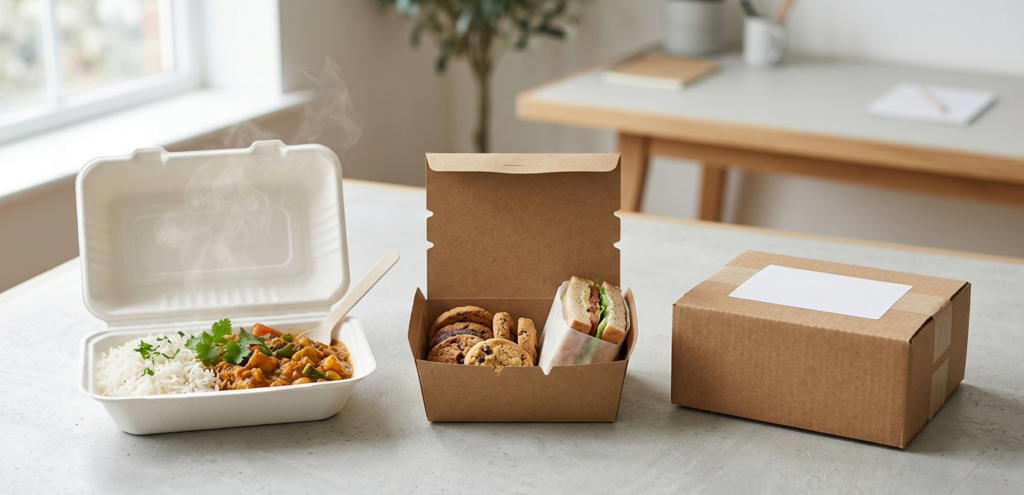
These boxes can replace many of the plastic-style packaging containers that many businesses use these days. That includes takeaway food boxes, meal trays, retail packaging boxes, and outer shipping cartons.
If done right, this switch can have significant benefits environmentally. Plus, it keeps your business compliant with the plastic regulations that are getting stricter over time.
What Options Are Available for Biodegradable Packaging Boxes?
When you search for biodegradable packaging boxes in India, you’ll notice that the market groups very different materials under one label.
Most “box-style” biodegradable packaging is fibre-based. That means it comes from plant fibres or paper. The manufacturing route matters because it tells you how the box will behave.
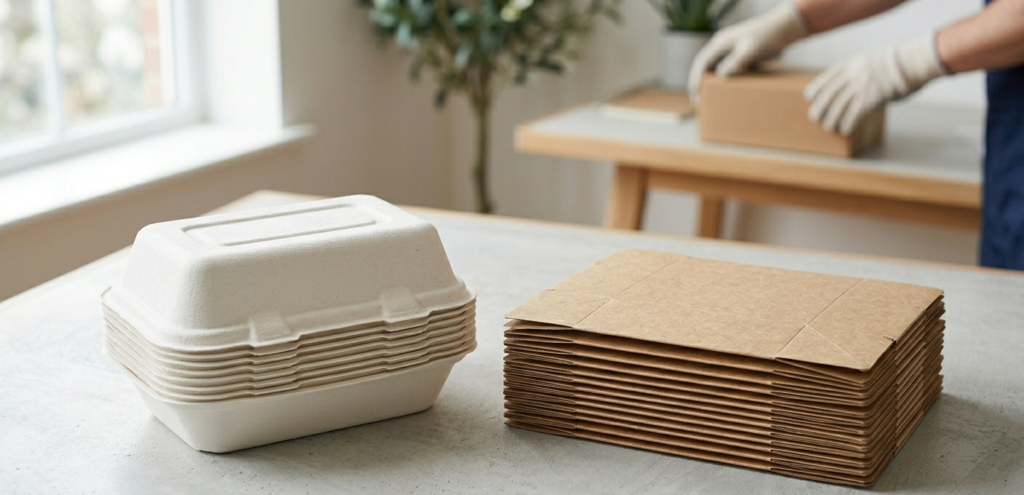
Some packs are made by moulding wet fibre into a rigid shape. Others are made by folding paperboard and sealing it. Corrugated cartons are built by bonding layers to create a cushioning, load-bearing structure.
Once you see these as three different construction methods, the choices become easier. You stop shopping by label and start shopping by use case.
Bagasse or Sugarcane Fibre Boxes
Bagasse is the fibre left after sugarcane is crushed. To make boxes out of this, manufacturers mix this fibre with water, form it in a mould, and then press and heat-dry it into a rigid container.
Because it’s made from moulded fiber, the boxes hold shape better under heat and moisture. That is why boxes made of these biodegradable packaging materials are widely used for:
- Hot meals and gravies
- Oily foods (curries, biryani, fried snacks)
- Items that release steam in a closed pack
Many bagasse boxes also come with lids and compartment designs. These are common in delivery and takeaway applications.
Kraft Paper Boxes
Kraft boxes are made from paperboard that is cut, creased, and folded into shape. These boxes hold shape nicely because of the folds, tabs, and glued or locked joints.
These boxes are most reliable for dry or low-moisture products such as:
- Bakery items, sandwiches, dry snacks.
- Retail packaging for cosmetics and apparel accessories.
- Eco-friendly gift packaging.
Kraft cartons are also easy to print. So, branding, labels, and product information stay clear.
Corrugated Boxes
Corrugated boxes are made by bonding a fluted paper layer between liner sheets. That flute acts as a cushion capable of absorbing shocks. That’s what gives these boxes their stacking strength and impact resistance.
That’s why corrugated boxes are most commonly used for:
- E-commerce shipping cartons.
- Warehouse storage and stacking.
- Heavier items, fragile products, and multi-item packs.
You will commonly see 3-ply for lighter loads and 5-ply for heavier or longer-distance shipping. The right ply depends on weight, drop risk, and how high boxes will be stacked in transit.
Paper Boxes with Coating or Lining
Sometimes paper is the right format. But plain paper is not strong enough against moisture or grease. In those cases, suppliers offer paper boxes with a barrier layer.
That’s why these boxes are particularly useful for:
- Foods that cause leakage or oil seepage.
- Dishes with sauces, gravies, and high moisture.
- Products where presentation matters but spill risk is real.
One important detail: the plastic lining complicates disposal and recycling. That’s because separating bonded paper and plastic is not always possible when processing waste.
So, you need to know what kind of plastic is used in the coating and what’s the best way to dispose of it.
Which Packaging Option Fits Your Business?
Now that you are familiar with some of the biodegradable packaging examples, it’s time to discuss how you can choose the best for your business.
The choice ultimately comes down to a few simple variables, such as:
- Is it a food product or a non-food item?
- Is it a dry or wet product?
- Will the boxes be stacked or compressed during delivery?
- Will the boxes be stored in humid conditions?
Answering these questions will give you a lot of clarity before sourcing biodegradable packaging boxes.
To make this even easier, let me walk you through some of the best sustainable packaging products based on specific sectors.
Food Businesses
For hot, wet, or oily foods, bagasse moulded-fibre boxes are usually the most reliable starting point. The reason here is simple: the moulded fibre containers are designed to stay stable with heat and moisture.
Furthermore, controlled tests on moulded pulp show good resistance to grease and hot liquids when the box is designed for it.
For dry foods like bakery packs and snacks, Kraft paper boxes are common. They store flat, print cleanly, and work well when there is low seepage risk.
Since the boxes will come in direct contact with the food item, they should meet all the food-safety standards. Make sure to confirm this with your supplier.
E-commerce and Shipping
For e-commerce, corrugated boxes are the safest default. That’s because they are built for stacking and long transit.
A corrugated box has a wavy paper layer in the middle. That wavy layer is called the flute. It works like a cushion. It helps the box absorb shocks and makes sure the boxes don’t crumple when stacked on top of one another.
This is why box specs matter. BIS standards describe different flute types and make the trade-offs clear.
Some flute profiles give better cushioning. Others fold better and take printing more cleanly. And the right choice depends on what you ship and how it moves.
Two practical points can help you make the right call. First, match the ply to the load. Second, factor in humidity since paper-based packaging can lose strength when it absorbs moisture.
Retail and Gifting
Kraft paperboard cartons are common for retail. They are easy to cut and fold into many styles. They print well and store flat. That’s especially helpful when you need thousands of boxes without using up warehouse space.
Kraft cartons work well for products like:
- Cosmetics
- Personal care
- Small FMCG items
- Apparel accessories
- Pharmacy-style packs
They are also the best option in eco-friendly gift packaging when the product is dry, and the box is not expected to withstand rough transit.
How Much Do Biodegradable Packaging Boxes Cost?
Once you know what options you have available in biodegradable packaging in India, the next thing is the price. How much do these biodegradable packaging boxes cost?
The price varies a lot based on the type and make of the boxes. For instance, a bagasse clamshell and a kraft folding carton can be the same size but with a different price tag.
Even within the same category, the unit cost may change mainly because of size and construction.
For example, a 350 ml bagasse bowl and a 1000 ml bagasse meal box are both made of the same material. But the bigger pack uses more material and often needs stronger shaping and a better lid. So, it naturally costs more.
The second thing is volume. Most suppliers quote in slabs: packs of 50/100 cost more per piece. Higher quantities bring the per-piece rate down.
To get a more accurate understanding of the cost, you need to first get the per-piece price. Then, you need to know what sort of discount buying in bulk will get you.
Below is an estimated cost comparison that will give you some idea:
| Box type | Typical per-piece price (small packs like 50–100) | Typical per-piece price (bulk order) | What usually changes the price the most |
|---|---|---|---|
| Bagasse food containers | ~₹4 to ₹15+ | Drops by ~5–15% with larger orders | Size, compartments, “anti-leak” design, and lid type. |
| Kraft paper meal boxes | ~₹5 to ₹8 | Drops by ~5–10% in larger slabs | Board thickness, printing, and grease/moisture barrier. |
| Corrugated shipping cartons | ~₹4 to ₹16 (basic) | Drops with volume; heavy-duty goes much higher | Ply (3/5), box size, strength spec, printing. |
What Biodegradable Actually Means in India
Shopping for biodegradable packaging in India can be rather confusing. Products are marketed as “biodegradable,” “bio-based,” and “compostable.” Some even use these terms interchangeably.
All these terms mean very different things. So, you need to know what biodegradable means before sourcing.
Paper, paperboard, corrugated fibreboard, and bagasse are all fibre-based materials. In normal conditions, they break down far more naturally than conventional plastics. That is why they are widely treated as biodegradable packaging options.
The confusion usually starts when plastic-like materials are also sold as biodegradable. For plastics, the rules are stricter. Compostable plastic products are expected to meet defined standards.
In India, compostable plastic carry bags must conform to IS/ISO 17088 and be CPCB certified before they can be marketed.
So, when buying, ask for clarity on the material. Also, ask for certification where it applies.
Where Should You Start if You Want to Switch?
The safest way to switch to sustainable packaging products is to do it like a controlled trial. Don’t attempt to change everything at once, as it can get messy.
Instead, you should start with one packaging item that meets at least one of these criteria:
- It is used in high volumes
- It is customer-facing
- It creates the most complaints today
Pick one material and test it in real conditions.
If you run a food business, test with your messiest items, not your easiest ones. Pack hot food, oily food, and high-moisture food. Check what happens after 30–45 minutes. That’s how you can simulate real delivery conditions.
If you are shipping products, test the box in the way your supply chain will treat it: stacking, movement, and storage. Humidity matters because fibre-based packaging can fall apart when wet.
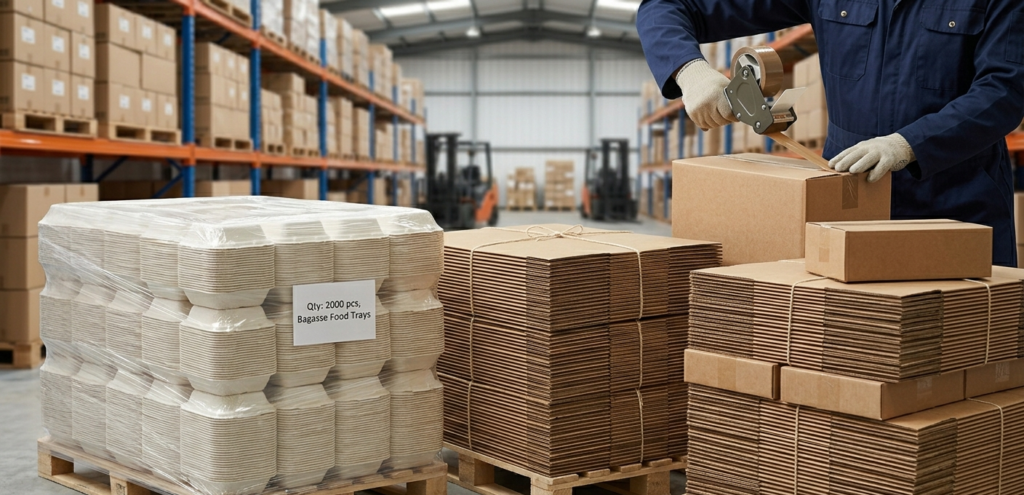
Finally, order a small batch first. Track cost per piece, breakage/leakage, and customer feedback. Once it works, scale in slabs for better pricing and consistency.
Conclusion: What to Ask a Supplier Before You Decide
Before you place an order, get clarity on a few basics. It will help you avoid issues later on. Ask your supplier the following questions:
- What material is the box made from?
- Is it suitable for my product?
- What is the GSM or thickness of paperboard?
- What ply is it for corrugated?
- Is there a coating or lining?
- What is the per-piece cost at my quantity?
- Can you share food-contact compliance or test documentation?
At Murth, we manufacture in-house. That matters because it lets us control three things that usually decide the overall quality. We develop biodegradable and compostable packaging from plant-based biomaterials.
When you buy from Murth, you can rest assured that consistency in quality, strength, and biodegradability will stay high across batches.