

What Goes Into Biodegradable Bag Production? Raw Materials Explained
When planning to switch to bioplastic, businesses typically focus on the problems they can see.
Single-use plastic is banned in many countries, including India. Plastic packaging is under intense scrutiny all over the world. Consumers favor brands that are mindful of their plastic waste.
Procurement teams are under constant pressure to source bioplastics packaging that works well with existing operations. But that’s where the confusion starts.
In the market, terms like biodegradable, compostable, and bioplastic often get used as if they mean the same thing. They don’t.
One term describes how a material breaks down. Another implies specific composting conditions and standards. And the third is about what the plastic is made from.
When these labels get mixed, teams end up comparing products that aren’t actually comparable.
That’s why knowing the basics of what biodegradable bags are made from is crucial. Once you understand the material chain, you can judge claims, performance, and cost with far more clarity.
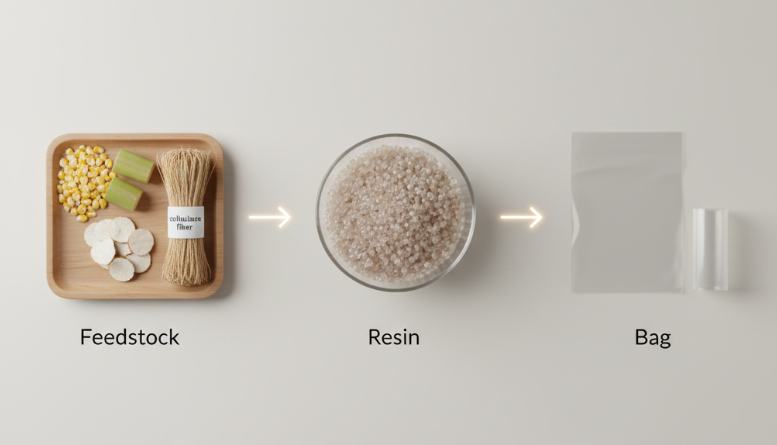
That’s why I like to explain it through a simple chain:
- Stage 1: Agricultural feedstocks (corn, sugarcane, cassava, and other biomass sources)
- Stage 2: Biopolymer resins (PLA, PHA, starch blends, often combined for performance)
- Stage 3: Finished bags (resin → film → bag)
This is the core of bioplastics packaging. The resin is what gets processed like plastic. On spec sheets, that resin is usually what people mean by biodegradable plastic bags manufacturing raw material.
Category 1: Agricultural raw materials or feedstocks
At the feedstock stage, we’re not talking about “plastic” yet. What we’re really choosing here is the kind of plant chemistry we want to start from.
Different plants give you different things in bulk, namely starch, sugar, or cellulose. These three raw materials behave very differently during further processing.
That’s why it helps to split feedstocks into two practical buckets, such as starch or sugar crops and cellulose-rich fiber crops.
Starch-Based Crops:
Corn, sugarcane, and cassava are used most often because they provide starch or sugar. These are the easiest plant materials to turn into bioplastics on a large scale.
Here’s the basic idea:
- These crops contain a lot of starch or sugar.
- That starch or sugar is extracted.
- It’s then converted into simple sugars.
- Microbes ferment those sugars to make chemicals such as lactic acid.
- Lactic acid is then turned into a resin such as PLA.
You can think of the pathway like this:
Plant starch → sugar → lactic acid → PLA resin → bag
So, what makes these crops the ideal biodegradable plastic bags manufacturing raw material? First off, these crops are produced in large volumes around the world. The quality is usually consistent.
Furthermore, starch extraction and fermentation are existing industrial processes. You don’t need to innovate new technologies for that. The overall conversion process is efficient and scalable.
Agricultural Waste from Hemp, Flax, and Nettle:
The key difference is simple. Corn, sugarcane, and cassava mainly provide starch and sugars. Hemp, flax, and nettle mainly provide cellulose fiber.
Cellulose is another natural polymer found in plant fibers. It gives plants their structure. Unlike starch crops, fiber crops are valued for their strong, cellulose-rich biomass.
Cellulose can be processed in a few ways. It can be treated mechanically or chemically to make biodegradable plastic bags from raw material. In other cases, the fibers are used as fillers or reinforcements in blends.
Fiber crops and residues are often considered the more sustainable options. It’s because they can offer several advantages.
For starters, they do not compete directly with food crops in the same way starch crops can. Then, depending on how or where they are grown, these crops require less water. Furthermore, these crops can improve soil health and biodiversity, especially in crop rotations.
This method makes use of plant parts like stalks, husks, and fiber as feedstock. These are considered agricultural waste that would otherwise be burned or thrown away.
At Murth, we turn such agricultural waste into bioplastic packaging. Our compostable and biodegradable plastic bags are made with biopolymer granules derived from agricultural waste. Hemp, flax, and nettle are the primary crops we rely on.
Category 2: What these raw materials become (biopolymer materials)
Agricultural raw materials are only the starting point. Before anyone can make a bag, those inputs have to be converted into biopolymer resins.
These resins behave a lot like conventional plastic in manufacturing. You can melt them, process them, and run them on film lines. The key difference is where they come from.
Instead of being made from fossil fuels, biopolymers are produced from renewable biomass. So, we’re talking about crops, plant sugars, and plant fibers.
PLA (Polylactic Acid):
PLA is one of the most widely used bio-based polymers in the world. It’s typically made from plant starch or sugar through a clear chain of steps.
First, starches are converted into sugars. Then microbes ferment those sugars to produce lactic acid. Finally, lactic acid is polymerised to form PLA resin.
PLA is popular in bioplastics packaging because it offers a good balance of performance and availability. It’s derived from renewable crops.
It can provide good clarity and strength. And it works well in many film and packaging applications.
PHA (Polyhydroxyalkanoates):
PHA is another biodegradable polymer, but it’s made in a different way. It’s not polymerised from lactic acid. Rather, PHA is produced directly by microbes.
Certain bacteria can consume sugars or plant oils. The bacteria then convert them into biodegradable polymers inside their cells. The polymer is extracted and processed into a usable resin.
The best part about PHA is that it is fully biodegradable. It can break down naturally in a wider range of conditions.
The main trade-off is cost. PHA is often more expensive than other options. So, it’s typically used in more specialized applications.
PBAT (Polybutylene Adipate Terephthalate):
PBAT is another common polymer used to make biodegradable bags. It’s used because it brings something PLA and starch often lack on their own: flexibility.
PBAT helps films bend, stretch, and hold up better in real use. It also improves strength, especially when you need the bag to be tear-resistant.
In packaging, PBAT is often added to improve:
- Flexibility
- Tear resistance
- Overall durability
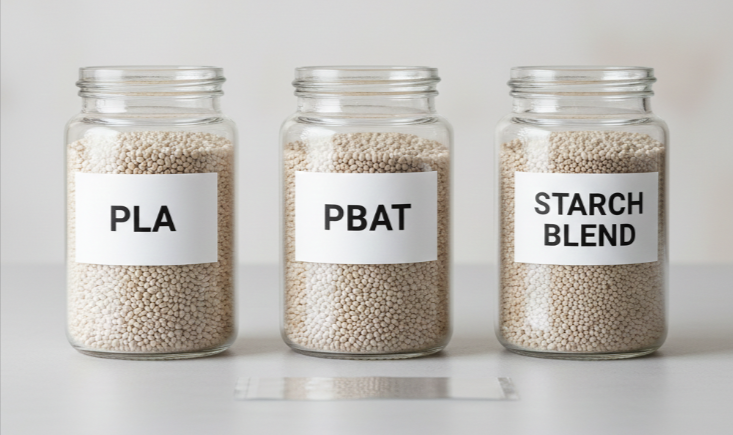
PBAT is most commonly blended with other biodegradable polymers like PLA and starch. It’s done to get a better balance of performance and processability.
Starch-Based Polymer Blends:
Starch is one of the most common plant-based inputs. But starch cannot be used on its own because of a crucial limitation. It tends to be brittle.
To make it work for films and bags, manufacturers typically blend starch with plasticizers and other biodegradable polymers. This creates a thermoplastic starch blend. It can then be processed more like conventional plastic and shaped into usable packaging.
These blends are used as a biodegradable plastic bags manufacturing raw material because they offer practical advantages like:
- They can reduce overall material cost.
- They can support compostability in the final product.
- They can improve sustainability
In the market, many compostable bag films are built around blends rather than a single resin. A common approach is to combine starch, PLA, and PBAT. It’s done to balance stiffness, flexibility, and strength of the final product.
Why are biopolymers blended to make biodegradable bags?
Most biodegradable plastic bags are made from blends. There is a practical reason for that. Each biopolymer has strengths, but it also has trade-offs.
If you try to use just one material, you often end up with a film that is too stiff, too brittle, too expensive, or not durable enough for real-world use.
Blending lets manufacturers combine materials so the final bag performs the way people expect. A simple way to think about it is to look at what each component typically contributes.
PLA provides:
- Strength
- Structure
- Stability
PBAT provides:
- Flexibility
- Tear resistance
Starch provides:
- Cost reduction
- Better compostability
When you blend them, you can tune the final material for the job. A carry bag needs a different feel than a garbage liner. A courier bag may need higher puncture resistance than a produce bag. Blends make that balancing act possible.
A helpful analogy is blended fabrics or metal alloys. Cotton and polyester are combined to get comfort plus durability. Metals are mixed to get strength plus corrosion resistance.
Biopolymer blends work the same way. You’re building a material system, not picking a single ingredient.
The end result is a film that behaves like plastic during use and manufacturing. But it is designed to be biodegradable under the right conditions.
How raw materials affect the final bag’s performance and cost
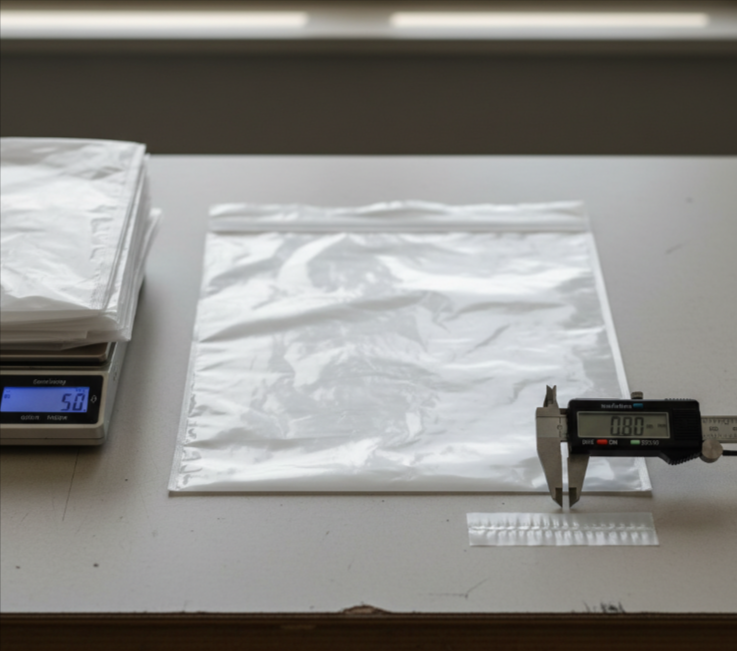
The raw materials you start with affect two things buyers care about the most: how the bag performs and what it costs to produce.
How It Affects Performance:
Different feedstocks and resin blends influence key features like:
- Strength: how much weight the bag can carry before it stretches or fails.
- Flexibility: how well it bends without cracking.
- Thickness: how thin you can go while still keeping strength.
- Shelf life: how stable the material remains during storage and transport.
- Compostability: how reliably it breaks down under the right composting conditions.
For example, a formulation with more structure-focused resin may feel stronger, but could become stiffer.
A formulation with a more flexible polymer may handle better in use. But it might need slightly more thickness to hit the same load rating.
This is why bag specs are almost always linked to the exact material system used.
How It Affects Cost:
Raw materials also drive cost in more than one way. They affect:
- Resin price: the direct cost of the biopolymer pellets or blend.
- Processing cost: energy, scrap rates, and how stable the run is.
- Manufacturing efficiency: how fast you can produce film without defects.
This is where the biodegradable plastic bags manufacturing plant cost starts to move. Two materials may look similar on paper. But one might run cleanly and consistently, while the other causes more downtime, more rejects, or lower output.
How It Connects to Machinery and Processing:
Most biopolymer resins are processed on the same broad types of equipment used for conventional plastics.
They can be extruded into films and molded into plastic goods. That means a standard biodegradable plastic bags machine setup can often be used with the right settings, temperatures, and handling.
But “can be processed” doesn’t mean “runs the same way.”
Feedstock choice and resin quality affect how the material behaves on the line. Higher-quality and more consistent inputs usually lead to better strength for a given thickness.
It may also mean more consistent film quality, smoother processing, and fewer interruptions.
Why Feedstock Selection Matters for Production Cost
In a manufacturing plant, raw material quality and polymer type show up in day-to-day operations. They can influence:
- Manufacturing efficiency: speed, downtime, scrap.
- Equipment compatibility: how stable the material is on existing lines.
- Overall production cost: waste, energy use, output per hour.
So, the material choice may start at the farm level. But it ends up affecting both the bag you hold in your hand and the cost structure behind making it.
Conclusion
By now, you should have enough clarity on the subject to be able to make smarter sourcing decisions. Instead of buying “biodegradable bags” as a generic category, you can now source based on what actually drives outcomes.
That helps you match material to use case, say, carry bags vs. liners vs. courier bags. It also helps you compare suppliers on real specifications such as strength, seal quality, consistency, and thickness.
Ultimately, it will help you understand why two quotes can differ so much. So, you’ll know exactly what you are paying for.