

The Importer’s Dilemma
If you’re an importer in the US, Europe, or the Middle East, you already know that sustainable packaging is no longer optional. Consumers are demanding it. Regulators are mandating it. Retailers are standardizing it.
But there’s one big question that stands between ambition and action:
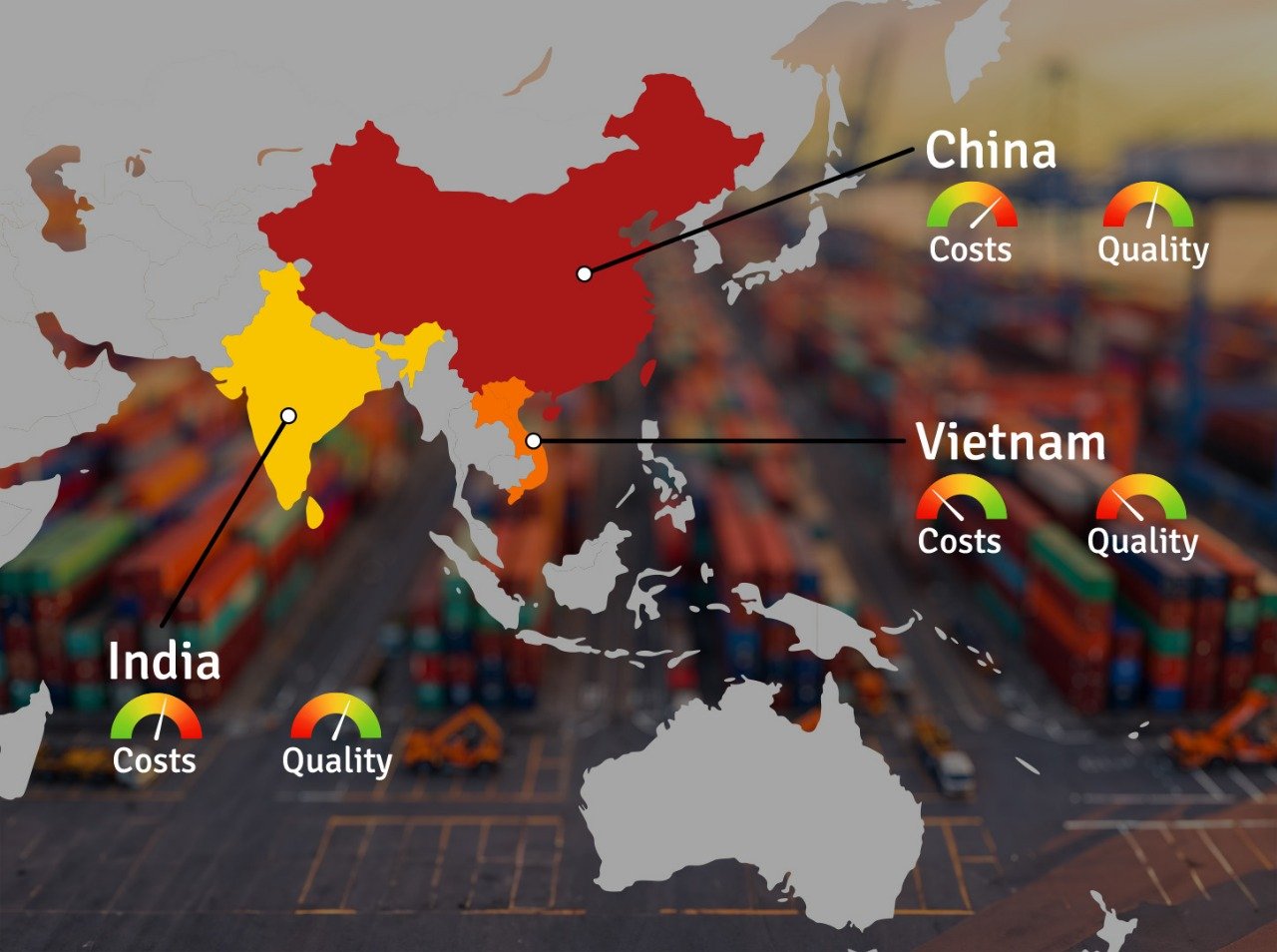
Where should you source from — India, China, or Vietnam?
Each of these three Asian manufacturing giants has carved a place in the global packaging supply chain. China dominates in capacity, Vietnam is emerging fast, and India is rising as the next sustainability powerhouse.
At first glance, they may seem interchangeable — but when you dig deeper into cost, compliance, innovation, transparency, and risk, stark differences emerge.
Let’s break it down, piece by piece.
1. Cost Comparison: China = Rising Costs, Vietnam = Mid-Range, India = Balanced
Price still drives sourcing decisions for most importers. But the equation has changed dramatically over the past five years.
🇨🇳 China: The Price Advantage That’s Fading
For decades, China was unbeatable on cost. But rising labor costs, energy prices, and environmental compliance fees have made it significantly more expensive to produce sustainable packaging there.
- According to 2024 data from Statista and Trading Economics, average manufacturing wages in China rose above $8,000 per year.
- Additionally, electricity tariffs and carbon tax policies introduced post-2023 have increased the cost of producing “green” materials (especially PLA, PBAT, and bagasse-based packaging).
- Freight rates from China to the US or EU remain relatively high due to long transit distances and port congestion, further squeezing landed margins.
🇻🇳 Vietnam: Competitive but Limited in Scale
Vietnam offers relatively low labor costs and is strategically located close to both China and ASEAN markets. However:
- Production capacity for compostable or bio-based packaging remains limited.
- Most factories may focus on plastic alternatives made from imported resins, not native bio-feedstock.
- Importers often face long lead times or small batch limitations for large-scale, compliant orders.
🇮🇳 India: Cost-Efficient, Scalable, and Resource-Rich
India strikes the sweet spot between price and production maturity.
- Labor remains cost-effective while raw materials like agricultural residues (bagasse, husk, cornstarch) are domestically available in abundance.
- Strong government backing for “Make in India” and “Plastic Waste Management Rules” (2016–2024 amendments) has pushed infrastructure growth in eco-friendly packaging.
- India’s logistics to Middle East, Europe, and East Africa are shorter and cheaper compared to China or Vietnam.
For importers seeking both value and volume, India offers considerably low landed cost per compliant unit in sustainable packaging categories (PLA, compostable bags, molded fiber, and biopolymer blends).
2. Compliance & Certifications: India Leads in EN/ASTM-Ready Exports
Compliance is where many importers burn their fingers. A shipment might look “eco-friendly” on paper but fail customs or retailer audits because it lacks internationally recognized certifications.
Here’s how the three sourcing hubs compare:
🇨🇳 China
- While many Chinese manufacturers do claim certifications, due diligence is critical. Fake or outdated certificates are not uncommon.
- Some factories are compliant with ASTM D6400 or EN 13432, but these tend to be large exporters with higher MOQs.
- Language and documentation barriers can cause miscommunication during audits or customs clearance.
🇻🇳 Vietnam
- Vietnam’s compostable packaging sector is still maturing.
- Few producers have TÜV Austria OK Compost HOME/INDUSTRIAL or EN 13432 certifications.
- Exporters often rely on foreign feedstocks (from China or Thailand), which may not be traceable at the batch level — a compliance red flag for EU importers.
🇮🇳 India
- India is now among the few countries producing fully certified compostable packaging with verifiable chain of custody.
- Many Indian manufacturers produce packaging that complies with:
- EN 13432 (EU standard)
- ASTM D6400 (US standard)
- ISO 17088 / ISO 14001 (process & environmental management)
- FDA and EU food-contact safety standards
On regulatory compliance, India leads decisively, ensuring smooth entry into both US and EU markets without certification surprises.
3. Innovation: India’s Agri-Waste, Seaweed, and Compostable Blends
True sustainability isn’t just about replacing plastic; it’s about rethinking materials altogether. This is where India’s innovation ecosystem shines.
🇨🇳 China
China’s innovation lies in scaling — not necessarily in pioneering new materials.
Most “biodegradable” packaging still relies on imported PLA or PBAT blends (petroleum-linked).
China is investing heavily in PHA and PBAT production, but genuine compostable R&D remains limited to large, state-backed firms.
🇻🇳 Vietnam
Vietnam’s innovation has been incremental: converting local rice husk or bagasse waste into molded packaging. However, supply chains remain fragmented.
The ecosystem is smaller, and collaboration between startups, universities, and government remains underdeveloped.
🇮🇳 India
India’s sustainable packaging growth is materials-led, not just manufacturing-led.
- Agri-waste valorization: Converting sugarcane bagasse, rice husk, coconut fiber, and hemp hurd into packaging materials.
- Seaweed and starch blends: Newer Indian startups are producing seaweed-based films and home-compostable wrappers with zero microplastic residue.
- Circular systems: Companies are exploring bio-additives and recyclate recovery loops to complement compostable materials.
India’s innovation edge lies in bio-origin diversity — giving importers unique, marketable sustainability stories while meeting certification needs.
4. Language, Transparency & Trade Communication
For international buyers, communication clarity is often the make-or-break factor.
🇨🇳 China
Despite imntprovemes, language barriers remain a pain point. Many suppliers depend on intermediaries or trading companies, which complicates communication and slows response time.
Transparency around raw material origin and certification traceability is often limited.
🇻🇳 Vietnam
Communication has improved with English-speaking account managers, but smaller suppliers may still struggle with complex documentation or audits.
Export paperwork (especially customs or compliance documents) often requires third-party assistance.
🇮🇳 India
India’s English-speaking workforce and export-oriented manufacturing base make collaboration smoother.
You can expect:
- Transparent documentation (certificates, test reports, trace logs)
- Real-time communication via English-proficient technical teams
- Proactive sharing of compliance material before shipment
For importers in the US, UK, or Middle East, this eliminates costly misunderstandings or documentation gaps.
India is the most importer-friendly ecosystem in Asia when it comes to communication, documentation, and transparency.
5. Geopolitics: Navigating Tariffs, Trade Wars & Stability
Geopolitical dynamics directly affect sourcing stability — tariffs, sanctions, or policy shifts can quickly erode supply security.
🇨🇳 China
- The US–China trade tensions continue to add unpredictability.
- Tariffs, anti-dumping duties, and scrutiny around “greenwashing” claims have made importers cautious about over-reliance on Chinese supply.
- EU importers also face growing consumer pressure to diversify away from China for ethical and resilience reasons.
🇻🇳 Vietnam
- Vietnam benefits from trade diversion — many companies moved operations there post-COVID to bypass China tariffs.
- However, overdependence on imported raw materials from China creates hidden vulnerabilities.
- Infrastructure strain and regulatory inconsistency sometimes lead to export delays.
🇮🇳 India
- India enjoys stable geopolitical relations with the US, Europe, and Middle East — all key importer destinations.
- India’s Strategic Partnerships with UAE and Saudi Arabia, and preferential trade terms (like UAE-India CEPA, effective 2022), simplify customs and reduce tariffs for certain goods.
- Government support for “Atmanirbhar Bharat” and export-oriented manufacturing further incentivizes eco packaging exporters.
For risk-averse importers, India is the most geopolitically stable and trade-friendly option in the region.
6. Murth’s Advantage: Bringing India’s Best to the Global Stage
While India offers all these macro advantages, the real difference lies in execution — consistent quality, verified compliance, and logistical reliability. That’s where Murth leads.
Compliance Built In
Every Murth product — from compostable films to mailers and liners — adheres to global standards.
Each export batch comes with full traceability and documentation, ensuring smooth customs clearance.
-
Material Innovation
Murth works with next-gen biopolymers and agricultural residues sourced ethically within India.
These materials not only meet performance requirements but also tell a sustainability story that resonates with conscious consumers abroad.
-
Scalable & Reliable Supply
With strong manufacturing capacity and ties to India’s logistics hubs, Murth ensures consistent supply at scale — from trial orders to container-load shipments — without the delays typical in fragmented supplier chains.
-
Communication Clarity
Global clients, particularly in the US, EU, and Middle East, choose Murth for its responsiveness and transparency. No translation barriers, no vague paperwork, no hidden costs.
-
Regional Expertise
Murth understands each market’s compliance and logistical nuances.
Why Importers Worldwide Are Shifting to India
For importers navigating the complex maze of sustainable packaging sourcing, India represents the next era — one built on compliance, innovation, and resilience.
- China gave the world scale.
- Vietnam offered agility.
- India is now offering sustainability with stability.
And Murth brings it all together — certified materials, transparent sourcing, and reliable delivery from India to your warehouse in the US, EU, or Middle East.
Compare once. Choose India. Partner with Murth today.
Sustainability should never come with uncertainty.
Sources
- Statista Manufacturing Labor Cost Data, 2024 – statista.com
- Trading Economics: Manufacturing Wages in Asia (2024) – tradingeconomics.com
- European Commission: EN 13432 Standard Overview – ec.europa.eu
- ASTM International: ASTM D6400 Compostability Standard – astm.org
- India’s Bio-Economy Policy 2022, Department of Biotechnology – dbtindia.gov.in
- Vietnam Ministry of Industry and Trade: Plastic Waste Roadmap 2023–2030 – moit.gov.vn
- UAE–India Comprehensive Economic Partnership Agreement (CEPA), 2022 – commerce.gov.in