

How Fast Do Biodegradable Garment Bags Break Down?
To replace single use plastic, multiple fashion brands and retailers are shifting to biodegradable alternatives made from bioplastic and/or paper.
But are biodegradable bags better for the planet?
How fast do biodegradable garment bags break down?
If you are looking to shift to eco-friendly garment bags to meet the growing regulations in India, UK or USA, check for recognised compostability certifications and clear end of life options.
For garment bags made from biopolymers, decomposition time determines whether a material actually reduces waste and delivers real ESG value. But to understand the time it takes for a material to biodegrade, we first need to be clear on what “biodegradable” actually means.
How does biodegradation work?
At its core, biodegradation is a biological process. Microorganisms, mainly bacteria and fungi, use materials as a carbon source.
But they can only do that if the material’s structure allows it.
The process usually unfolds in stages:
- Heat and moisture soften the material
- Enzymes break long polymer chains into smaller units
- Microbes consume these units and convert them into CO₂, water, and biomass
For example, PLA based garment bags need sustained heat (around 55-60°C) before microbes can act efficiently. But starch-based materials are digestible at much lower temperatures.
In simple terms, if microbes can “eat” it easily, breakdown is faster.
But without industrial composting conditions and proper certification, biodegradable garment bags can take years to degrade or leave toxins behind.
A certified biodegradable garment bag is compostable when microorganisms can break it down into:
- carbon dioxide
- water
- biomass
without leaving harmful residues.
But the degradation must happen within a defined time and under defined conditions.
So, it is best to rely on standards like:
- ASTM D6400
- EN 13432
- ISO 17088
These require roughly 90% decomposition within 180 days in controlled composting environments, plus strict limits on toxic residue.
Anything that doesn’t meet these benchmarks may fragment but not fast enough to make a meaningful difference.
This is also why vague terms like “eco-friendly” or “degradable” are increasingly restricted. Without certification, they don’t tell us how fast, where, or if a breakdown actually happens.
It is also important to mention that “biodegradable” and “compostable” are two terms that are regulated differently. But to make things simpler we will use them interchangeably going forward.
How fast do compostable garment bags decompose in industrial composting?
In industrial composting, compostable garment bags decompose under ideal conditions:
- temperatures of 55-60°C
- controlled moisture
- constant oxygen supply
- active microbial populations
So, certified compostable garment bags show predictable timelines. As per lab data and field trials:
- Disintegration begins within 2-4 weeks
- Most thin film sustainable garment bags break apart in 8-12 weeks
- Full biodegradation below 2 mm completes within 90-180 days
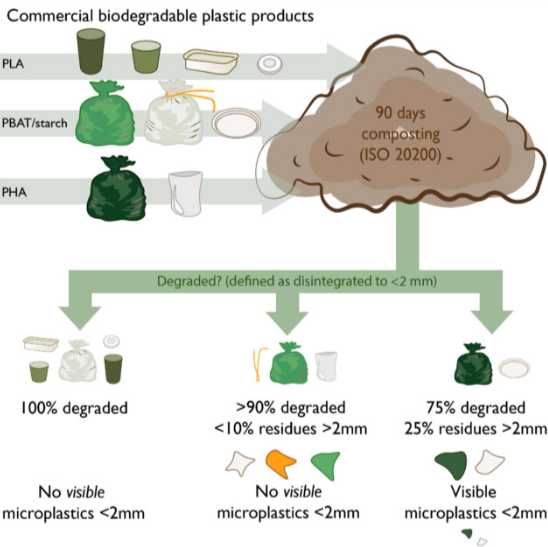
In a 2025 Scientific Reports study, three different certified compostable plastic films were found to disintegrate (in less than 2mm fragments) within 90 days.
But different materials behave differently:
- PLA-PBAT blends often complete composting in 3-4 months
- PHA-based films can finish even faster, sometimes in 60 days
But most garment bags don’t end up in industrial composts. So what happens outside this controlled environment?
How fast do biodegradable garment bags degrade in home composting?
Now, let’s step outside the industrial setting. In home composting, the results are different.
Your backyard bin is not a lab and temperatures rarely cross 30°C. Microbial activity also swings with the weather.
So what does that mean for home compostable garment bags?
For many “compostable” plastics, especially PLA based bags, breakdown is dramatically slower at home.
Only some special blends, like certain PBAT starch bags, are certified for “OK Compost HOME,” meaning they should disappear within 12 months at ambient temperatures
But some experiments reveal a tougher reality.
The UCL Big Compost Experiment found that after months, over 60% of home compostable plastics still left visible fragments in UK garden bins.
Some bags, especially those with thicker walls or that rely on high heat, can linger for years in a home pile.
In short, home composting is currently unreliable for most “biodegradable” garment bags.
They break down much more slowly and sometimes not fully at all.
So what if a bag doesn’t make it to any compost and simply gets trashed or littered? Let’s look at that next.
What happens to compostable garment bags in landfills or the open environment?
If a biodegradable garment bag ends up in a landfill, the decomposition process slows almost to a standstill.
Landfills are oxygen poor and microbial activity is minimal. Even food waste and paper can stay intact for decades.
Studies have unearthed newspapers, hotdogs, and even guacamole from landfills preserved for over 25 years.
So, if a compostable bag like, PLA and PBAT) is littered in the open or ends up in water, it will mostly persist for years in soil or seawater.

A Plymouth University study found that some “biodegradable” bags still held groceries after 3 years in the ocean.
So, biodegradable does not mean that a bag disappears anywhere, anytime.
But there are some bioplastics that can decompose in open environments.
Which biodegradable garment bag materials break down faster?
The speed at which a biodegradable garment bag disappears depends on what it’s made from.
- Starch-based bags break down the quickest.
- PHA-based films are impressive, even in marine environments.
- PLA needs heat, slow in home or natural settings, faster in industrial.
- PBAT sits in between. It is better than PLA outside compost, but not as quick as starch or PHA.
But materials like oxo-degradable plastics are not truly biodegradable. They just fragment, leaving microplastics behind, and are banned in the EU.
Here is a quick rundown:
| Material Type | Industrial Compost | Home Compost | Soil/Marine |
| Starch blends | 3 months | 6–12 months | Few months to a year |
| PHA | 1–2 months | More than 1 year | Several months to a year |
| PLA | 3–6 months | More than 2 years | Years to decades |
| PBAT | 3–4 months (blend) | Months, years | 1 to 2 years |
| Paper/cellulose | Few weeks to months | Months | Months |
The bottom line is that if you want a garment bag to vanish fast, material choice is critical.
At Murth, we offer certified compostable garment bags and other eco-packaging solutions, including PLA-PBAT and starch blend thin films. Our sustainable bioplastic bags are customisable to include zips and/or flaps like traditional plastic ones.
FAQs
How long do biodegradable garment bags decompose in industrial composting?
Certified biodegradable or compostable garment bags decompose within 90-180 days in industrial composting systems, where temperatures, moisture, and microbes control consistently.
Do compostable garment bags break down in home compost bins?
Home composting is slower and many PLA-based bags need higher heat. So, they may take six months to two years. Only bags certified OK Compost HOME reliably disappear within 12 months in real home bins or heaps.
Will biodegradable garment bags break down in landfills or the ocean?
No. In oxygen poor landfills or cold seawater, compostable bags are expected to persist for years and may not fully biodegrade or fragment.
Which materials break down fastest among sustainable garment bag options?
Starch-based blends and PHA films break down fastest, usually within weeks to a few months in compost. PLA needs industrial heat, PBAT and blends perform moderately faster than PLA but slower than starch in tests.
What certifications should buyers look for on biodegradable garment bags?
Look for ASTM D6400, EN 13432, ISO 17088, or OK Compost HOME to confirm industrial or home compostability and breakdown.