

A Complete Guide to Bioplastics Packaging for Ecommerce Brands
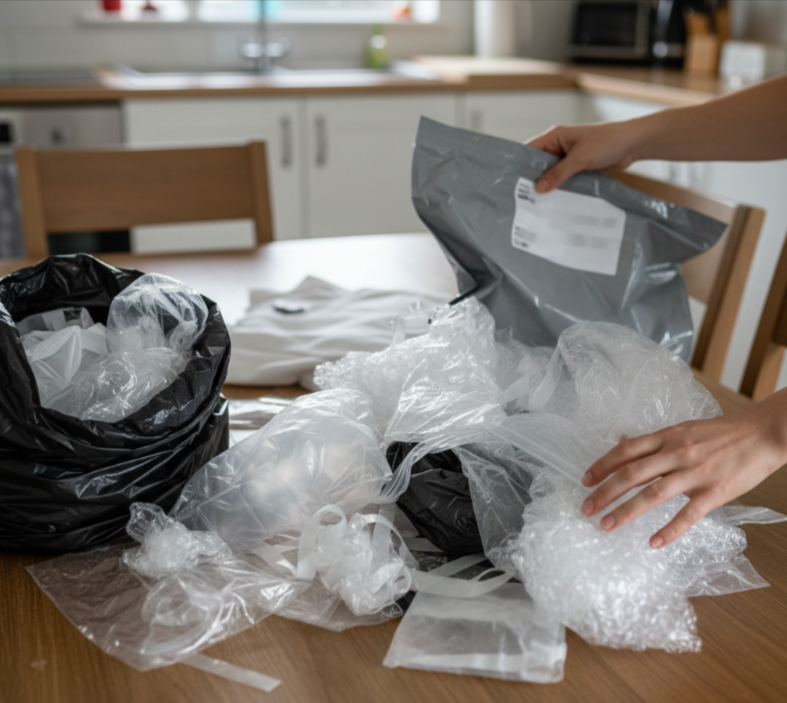
E-commerce has made plastic packaging the default. Not because brands love plastic, but because it’s been the easiest way to ship fast, cheap, and at scale.
The problem is that if this keeps compounding year after year, there will be an overwhelming environmental cost. Globally, plastic waste has more than doubled since 2000, reaching 353 million tonnes in 2019. And only about 9% of it was recycled.
Now, let’s bring that down to a single order. A typical shipment also isn’t just one bag. There’s a courier bag, a garment polybag or inner sleeve, and sometimes even a carry bag.
This kind of packaging lasts far longer than the product itself. And because of its environmental impact, plastic packaging is also attracting tighter scrutiny from governments around the world. That’s why many brands are looking at biodegradable e-commerce packaging as a practical switch.
In this guide, I’ll explain what bioplastics packaging is, how to compare costs properly, and how to evaluate suppliers and real adoption.
What is bioplastic packaging?
Bioplastic packaging refers to any plastic packaging that’s made from organic materials. This type of packaging looks and functions like regular plastic, but breaks down differently after it’s discarded.
Most conventional plastic is fossil fuel-based. It stays in the environment for a very long time. Bioplastics, especially those that are compostable, break down completely within months.
In India, the most useful term to focus on is compostable packaging. It’s because that’s what certification and compliance frameworks are built around.
So, from a sourcing standpoint, e-commerce businesses should go for bags and films made to meet compostability standards.
What are Bioplastics Usually Made From?
What it’s made from varies. Many bioplastics are made from plant-based raw materials such as starches, sugars, or cellulose.
In newer supply chains, you’ll also see agricultural residues and plant fibres used as feedstocks or fillers. Bast-fibre crops and similar plants are mostly used for this purpose.
So, agricultural waste from plants like hemp, flax, and even nettle is used to get the necessary raw materials.
Types of Biodegradable Packaging Available for E-commerce Companies
For most ecommerce business, switching everything in one shot may feel disruptive. A more manageable alternative is to switch to bioplastic packaging format by format.
You need to start with the highest-volume items. In e-commerce, that usually means:
- Courier mailers
- Shipping pouches
- Inner garment polybags
- Garment sleeves
- Carry bags
Other than that, biodegradable plastic carrier bags can be used for retail handovers. And for warehouse waste handling, businesses can switch to biodegradable plastic bin bags.
What Makes Bioplastic Packaging an Ideal Alternative for E-commerce?
E-commerce businesses need packaging that is consistent, scalable, and easy to deploy across thousands of daily orders.
Bioplastic packaging fits because it looks and functions like regular plastic without the same environmental cost.
For many brands, it’s the most practical way to improve packaging outcomes without slowing fulfilment down.
Cost of bioplastics packaging vs plastic: What ecommerce brands need to know
When switching to biodegradable ecommerce packaging, the biggest concern businesses have is related to cost. And rightfully so.
You’re buying at scale, you’re trying to avoid stockouts, and you need something that performs the same way every day on the packing line.
That’s exactly why cost comparisons have to be done the right way.
If you use the wrong reference point, you can end up rejecting an option that’s actually cheaper in real operations. Or, you may end up approving one that looks cheap only on paper.
Why Price Per Kilo is Misleading
Most buyers still compare packaging on one number: ₹/kg. It feels objective, but it’s also where many decisions go wrong.
In India, plastic carry bags must meet a 120-micron minimum thickness requirement under current rules. This pushes up the material used per bag.
Compostable and biodegradable packaging in India doesn’t always sit under the same minimum thickness condition. Of course, product category and certifications matter.
So, in many common use cases, the compostable option can be lighter per piece. That changes the math in a very practical way.
You can get more bags per kilogram when the bag uses less material per unit. So a higher ₹/kg can still translate into a lower cost per usable bag.
If you’re shipping orders, you don’t use “kilograms.” You use pieces of bags, one per order, sometimes more.
Cost Per Bag is the Correct Comparison
The cleanest way to compare is to put both options on the same operational unit: ₹ per bag. That is the number your dispatch volume actually multiplies.
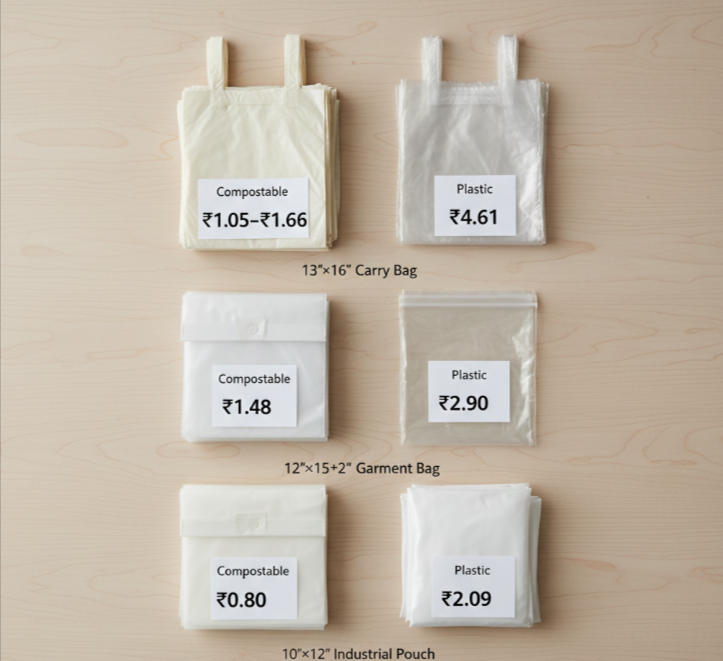
Here are a few real-world per-piece examples:
| Packaging type | Bioplastic price (₹/bag) | Plastic price (₹/bag) |
| Carry bags (13″ × 16″) | 1.05–1.66 | 4.61 |
| Garment bags | 1.48 | 2.90 |
| Industrial pouches | 0.80 | 2.09 |
The takeaway is straightforward. Even if bioplastics packaging looks costlier per kilogram, it can be cheaper per usable unit.
In the carry bag example, the gap is roughly ₹3 per bag. At 1,000 bags a month, that’s about ₹3,000/month saved.
How to choose the right bioplastics packaging supplier
After you understand the math behind the switch, it’s time to talk about how to actually source the right biodegradable e-commerce packaging.
Buying the wrong product or buying from the wrong supplier can make this process more complicated than it has to be.
Here are a few steps you can take to make sure you’ve chosen the right bioplastic manufacturer:
Verify Certification and Compliance:
When looking for biodegradable ecommerce packaging, don’t rely on labels like “Oxo” or “bio” or “eco.”
Ask for proof that the finished bag you’re buying is certified and not just the resin. Then cross-check that the certificate matches:
- The exact product type
- The size and thickness range
- The supplier name and validity period
If the paperwork doesn’t map cleanly to the SKU you’ll receive, treat it as a red flag.
Evaluate Supplier Consistency and Manufacturing Capability
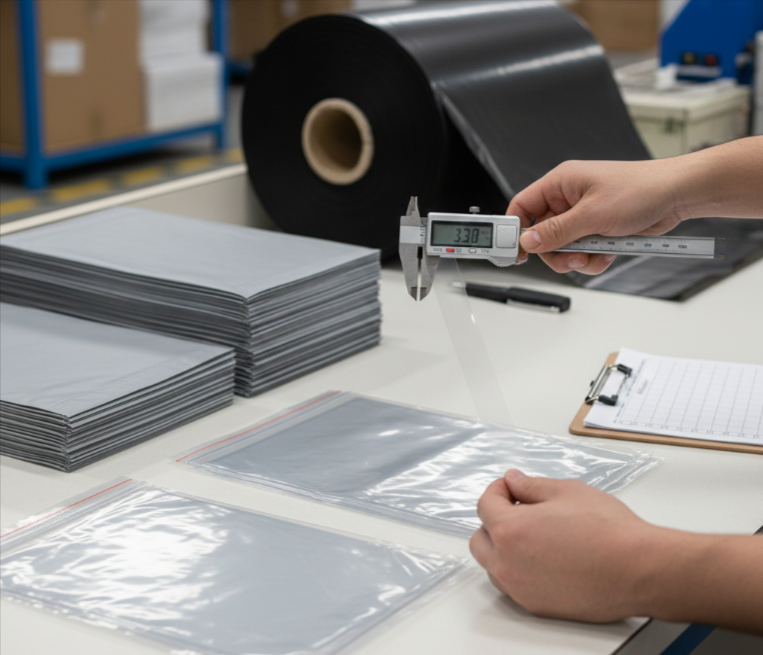
Ask for a pre-production sample, but don’t stop there. The real test is whether batch #3 looks like batch #1.
Check the basics that affect dispatch:
- Does it stay sealed after handling?
- Are there thin patches that tear?
- Does the size stay stable across cartons?
- Does a shipping label stick properly?
A serious manufacturer will define tolerances and show you how they control them.
Clarify Reorder Timelines and Supply Stability:
Get clear answers to three questions before you commit:
- What is the standard lead time for repeat orders?
- What is the MOQ for reorders?
- What happens during peak demand?
- Can you ramp up without changing specs?
If these aren’t predictable, your packaging becomes a dispatch risk.
Ensure Functional Compatibility with Your Existing Packaging Needs
Don’t redesign your packing process around the bag. Match the bag to your process.
The right supplier should replicate your current sizes and performance so your team can pack the same way. That means the same handling, the same workflows, and no machine changes.
With the right supplier, you get predictable performance, consistent quality, and proof of compliance. That’s precisely what Murth stands for.
We work with compostable and CPCB-certified bags made from farm and agricultural waste. Our bioplastics packaging matches traditional plastic in both appearance and performance.
Murth can help you make the switch effortlessly. You won’t have to slow down operations or chase paperwork.
Examples of Indian brands using bioplastics packaging
The e-commerce industry in India and around the world is now taking the switch more seriously. Packaging is being treated less like a low-cost commodity and more like a controlled input.
Brands want materials that behave predictably on a fast packing line, while also complying with government regulations and reducing environmental impact.
Amazon India:
Amazon’s packaging work in India is a good example of how big systems approach change. It has described a multi-year effort to reduce packaging and eliminate single-use plastic from its fulfilment packaging.
It’s also working on alternatives such as materials derived from agricultural waste through partnerships like the one with IIT Roorkee.
Nykaa:
Nykaa’s Integrated Annual Report (2024–25) outlines ongoing efforts to improve packaging sustainability. The focus is on reducing impact through material choices and better packaging practices.
It’s not framed as a one-time switch, but as a continuing packaging transition across the business.
FabIndia, Chumbak, and Forest Essentials:
An industry report from UN Global Compact Network India cites these brands in the context of moving toward compostable/biodegradable packaging approaches across consumer categories.
This suggests the shift isn’t limited to pure-play ecommerce. It spans lifestyle and premium retail, too.
Put together, these examples show why biodegradable ecommerce packaging is becoming operationally viable. Formats are stabilising, and adoption is spreading beyond pilots into real workflows.
Conclusion
E-commerce isn’t slowing down, which means packaging demand won’t slow down either. That’s why bioplastics packaging is becoming a practical option for e-commerce brands.
In most cases, it can replace the everyday formats you already use, like courier bags, carry bags, garment polybags, and bin liners, without disrupting fulfilment. As long as specifications are matched, the switch should be smooth.
But the decision has to be evaluated correctly. Cost only becomes clear when you compare per usable unit, not per kilogram. And performance only stays stable when the supplier can deliver consistent batches.
Brands that understand these basics now can assess options with more clarity. That’s how you can make packaging choices that are both operationally sound and future-ready.