

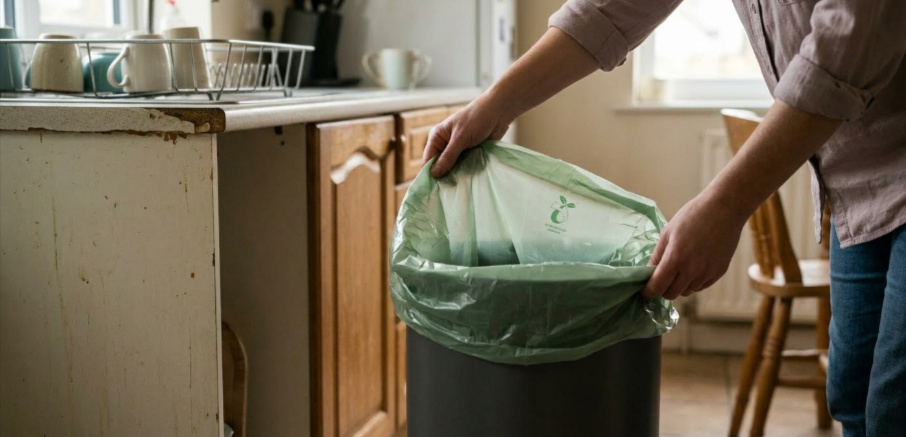
Compostable Rubbish Bags: Do They Actually Hold Up?
If you are planning to switch to compostable rubbish bags, you’ve probably asked a very practical question first: Will these bags actually hold up the way plastic ones do?
The skepticism is fair. You may have heard that compostable garbage bags tear too easily or leak at the bottom. You may even worry that since the bags are compostable, they will start breaking down right inside the bin. They don’t.
If you’ve had a bad experience with compostable bags before, it’s probably because they were made with inconsistent resin blends. Or it may be that they were too thin or had weak sealing.
In most cases, the issue isn’t so much that compostable rubbish bags are weaker. It’s that they don’t perform as well as expected when they are made to poor specifications.
The good news is that compostable bag manufacturing in India has improved a lot in the last few years. Regulations have become clearer on what “compostable” can mean, and testing infrastructure has expanded.
That has pushed the market toward more consistent materials and better manufacturing control. But how do compostable rubbish bags perform in everyday use? That’s what we’re going to explore here.
How compostable rubbish bags compare with plastic bags
Conventional plastic rubbish bags are cheap, easy to find, and they usually do the job. So, the first thing you would want to confirm is whether compostable rubbish bags can work as well as conventional plastic ones.
In most instances, the answer is yes, compostable rubbish bags can perform like plastic in daily use. But it also depends on what kind of compostable bag it is.
Across both plastic and compostable, four things decide how well a bag performs in real use:
- How much weight it can carry
- How easily it tears once nicked
- Whether it leaks under wet waste
- How stable it remains before use
Take a simple example. A standard medium-duty plastic garbage bag is usually around 18 to 25 microns thick. And it is typically designed to handle 6 to 10 kg of mixed household waste.
Increase the thickness to 30 to 40 microns, and that capacity can go well above 10 to 15 kg, depending on sealing and film quality.
Compostable bags are no different in principle.
If they are made at similar thickness levels, with the right material blend (often PBAT-based for flexibility) and proper sealing, they can carry comparable loads for everyday use.
But if they are made thinner, or with inconsistent blends, they may tear much more easily. So, the comparison is not plastic vs compostable. It’s spec vs spec.
How long do compostable rubbish bags last before they start breaking down?
A common worry is that if a bag is compostable, it might start breaking down too early. In normal use, that does not happen.
Compostable bags are designed to stay stable during storage and everyday use. They do not start dissolving just because there is wet waste inside the bin.
Composting requires a very different environment. It needs a mix of:
- heat
- moisture
- oxygen
- microbial activity
Compostable rubbish bags break down only in industrial composting systems. Not in household storage and certainly not during use inside garbage bins.
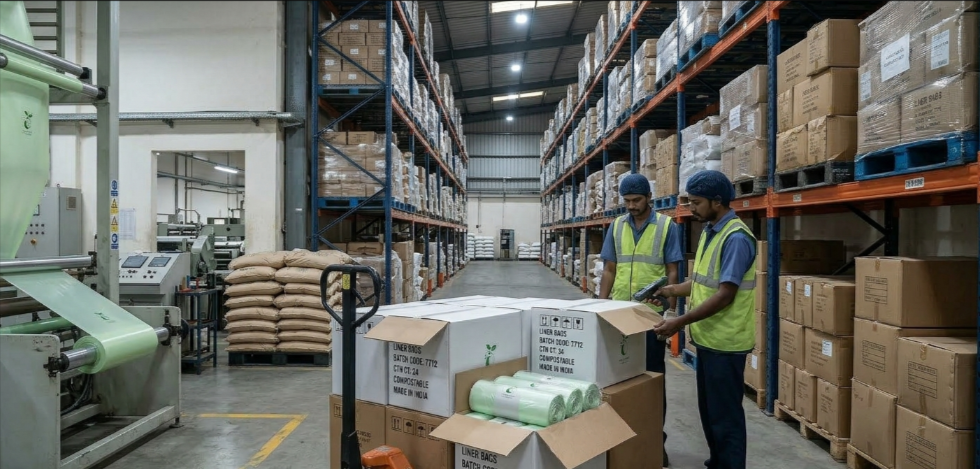
Where people do run into problems is shelf life and storage handling. Like any polymer film, compostable films can age faster if they are stored poorly. High heat, high humidity, and direct sunlight can reduce strength over time.
So, if you’re buying compostable packaging bags for regular use, treat storage as part of performance. Keep cartons sealed and store them in a cool, dry area. Also, avoid leaving these bags open near windows or hot machinery.
The thickness of the bag makes a big difference
Thickness is the quickest way to predict how a rubbish bag will perform in daily use. It’s the first thing you check because it influences the bag’s durability.
It’s measured in microns (µm), and a higher micron number usually means there is more material in the bag. That makes the bag more resistant to tearing and puncturing.
That’s why many household kitchen bags used for wet waste are often in the 60-100 micron range. They need that extra margin to handle food scraps and liquid-heavy rubbish without failing.
But there is an important nuance. Thicker does not automatically mean stronger.
Two bags can have the same thickness and still behave very differently. That happens if one has a better material blend or more consistent film and sealing.
For compostable rubbish bags, thickness is selected based on the type and weight of the waste they are expected to handle.
Medium-duty compostable bags often sit in the 25-50 micron range. Thicker options are used for heavier waste.
The seal of the bag is just as important as the material
Most rubbish bags break at the bottom seal. That’s the part that takes the highest stress when you lift a full bag. If the seal is weak, two things tend to happen:
slow leaks that start at the corners
sudden splitting right when you pick the bag up
The film may be strong enough, but if the seal is weak, the overall performance goes down.
Modern compostable bags can be sealed very reliably, but sealing has to be done right. Temperature, pressure, and dwell time all affect seal quality. And different films need different sealing settings.
So, when you evaluate compostable rubbish bags, don’t just ask what they are made of. Ask how they are sealed, and what checks are used to ensure the seal holds under load.
Load capacity determines how much waste a bag can hold
The load capacity of rubbish bags depends on a few variables, such as:
- thickness
- material blend
- film strength
- bag dimensions
- seal strength
This is why two bags that look similar can behave very differently once you start using them. One might handle wet kitchen waste without a problem. Another may stretch, tear, or split at the seal when the weight shifts.
A simple way to think about it is by use case.
Light office waste is mostly dry and low-weight. Kitchen waste is heavier and moves around because of moisture. Mixed rubbish can include sharp items that create puncture points.
So, before you buy, confirm what the bag is meant to carry. If you’re comparing compostable bags price, compare them against the load class and thickness you actually need.
What has changed in the last few years in the compostable bags manufacturing
A big reason compostable bags perform better today is that the ecosystem around them has matured.
A few years ago, many products in the market were inconsistent. Material blends varied from batch to batch. Film quality fluctuated. Seals were not always tuned for the material.
In India, that has started changing for two reasons:
First, the rules around compostable plastics have become clearer. Regulators have pushed for stricter definitions and labeling.
Second, testing and certification capacity have expanded. More manufacturers now work against defined standards. And buyers are more likely to ask for proof instead of accepting vague claims.
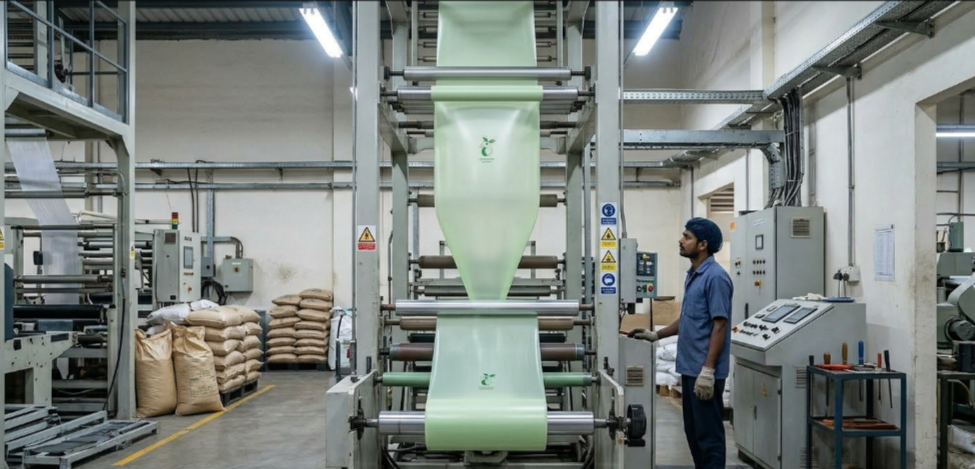
On the manufacturing side, extrusion and sealing technology have improved, too. Better blends, processing control, and sealing have reduced the kinds of failures people used to associate with early compostable bags.
What should buyers look for when buying compostable rubbish bags?
If you’re buying compostable rubbish bags, here’s a quick checklist you can run through before you place an order:
- Compostability standard:
Ask which standard it complies with: IS/ISO 17088 (India), ASTM D6400 (US), or EN 13432 (EU). If they can’t name the standard, that’s a red flag.
- Thickness and consistency:
Find out how thick it is and whether it can handle the type of waste. Also, ask if they control gauge variation across batches.
- Seal strength:
Ask what seal type they use and how they verify it. Methods like ASTM F88 are commonly used to test seal strength.
- Load capacity:
Ask for an expected load range for wet waste vs mixed waste.
- Performance basis:
If you’re buying compostable bags wholesale, ask if they test for tear and impact resistance. ASTM-style methods like D1922/D1709 are commonly referenced.
At Murth, we make these bags in-house. So, we can tell you the exact micron range, the seal type, and the load range the bag is designed for. We also run production checks that catch the real-world failure points before the bags leave the plant.
Conclusion
The next step is to match the bag to your waste, and then check the spec.
Start with the use case. Is this for wet kitchen waste? Dry office waste? Mixed rubbish? Then, shortlist based on thickness and size.
After that, ask the supplier a few clear questions:
- Which compostability standard do the bags meet?
- How do they check seal strength?
- What load range is the bag designed for?
If you’re planning to place repeat orders, ask how they keep thickness consistent across batches. And before you commit at scale, run a small trial in real conditions for a few days. It’s the fastest way to remove doubt.