

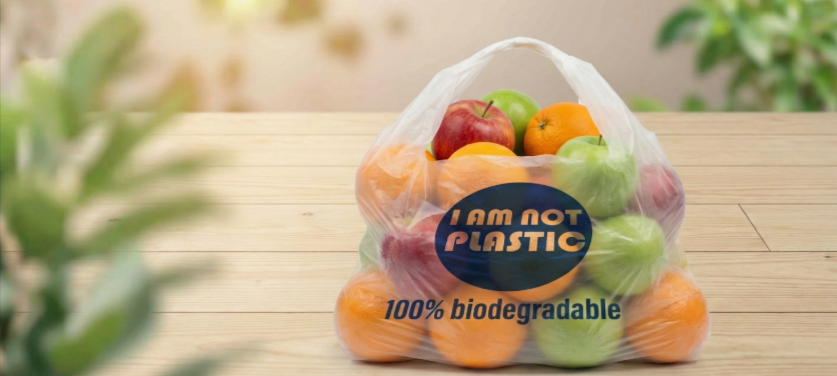
How Much Do Biodegradable Plastic Bags Cost in India? A Price Breakdown
When I speak to buyers , there’s one question I get more than any other: “Are bioplastic bags really affordable, or is this just another green premium?”
Let’s cut straight to it.
Today in India, the price of biodegradable plastic bags is not only competitive but often lower than traditional plastic. This is especially true if you know where to look and what drives those numbers.
If you want clear answers and practical insight into the cost landscape – you’re in the right place.
Let’s break it all down by size, supplier, and the actual market rates for 2026. I’ll also show you why at Murth, we don’t just claim to be affordable but also prove it with every shipment.
How Are Biodegradable Plastic Bags Priced in India?
Most people don’t realize there are two worlds when it comes to biodegradable plastic bags price in India:
The wholesale market which is mostly B2B. It is priced per kilo and minimum order sizes range from 50 – 100 kilos.
Like all commodities there is also retail space. Sellers offer products priced per roll and even per bag. Needless to say this option always costs more.
Let’s talk about wholesale prices first.
A typical biodegradable carry bag (let’s say, 13×16 inches) is currently quoted at:
| Size & Type | Price Range (₹/kg) | Who’s Selling? |
| 13×16” carry (standard) | ₹98–135 | Dr. Ecobiopack, Jezdec |
| 13×16” carry (mid-market) | ₹130–170 | BioBaggy, Vasu Polymer |
| 13×16” carry (premium) | ₹200–400+ | Navkar, AAvani |
Most certified and mainstream brands cost between ₹100 – 200/kilo.
That means if you’re running a fashion business in Pune or Bengaluru buying 200 kilo/month, your total outlay is completely predictable.
Switch to retail pricing, and you’ll see the same bags sold by the pack, bundle, or roll. For example:
- A pack of 19×21” compostable garbage bags (common for household bins) can run anywhere from ₹3 – 10 per bag. The cost varies depending on the brand and channel.
- Jumbo bags (for large bins) are mostly priced in the ₹14 – 20 per bag range in small e-commerce packs.
Why the spread between wholesale and retail?
Because retail pricing also accounts for packaging, shipping. Besides smaller pack sizes carry a premium..
Wholesale markets on the other hand are about scale, efficiency, and direct supply.
But what are the actual going rates by size and application? Let’s dive into specifics so you can negotiate from a position of strength.
What Are the Current Market Rates for Biodegradable Bags by Size?
Market rates for biodegradable bags in India are quite affordable if you know where to look.
Here’s what you’ll find in 2026, straight from manufacturer listings, B2B platforms, and major suppliers.
A. Carry/Shopping Bags (W-cut, D-cut, loop handle, etc.)
| Size & Supplier | Typical Price (₹/kg) | Notes |
| 8×10″ to 13×16″ (standard) | ₹98–135 | Dr. Ecobiopack, Jezdec, BioBaggy |
| 13×16″ to 16×20″ (mid/high) | ₹130–170 | Vasu Polymer, Yuvika, ExportersIndia aggregators |
| 13×16″ premium/brand-positioned | ₹200–400+ | Navkar, AAvani |
- Usual range is between ₹100 – 200/kilo for most mainstream, CPCB/ISO-certified bags
- Premium, customised or high-finish bags can hit ₹400+/kilo, but that’s the exception.
B. Garbage Bags (household, commercial, institutional)
| Size/Class | Typical Price (₹/kg) | Brands |
| 17×19″ to 19×21″ | ₹85–170 | Baroda Packaging, BioBaggy, Yuvika |
| Large/Jumbo (30×40″) | ₹140–250 | Navkar, VEDHAN, Raga Plus |
| Low-price outliers | ₹30–50 | Reliance Packaging (always check certification!) |
Retail packs are priced higher:
- Medium garbage bags (17×19″, 19×21″) typically cost ₹3 – 10 per bag
- Large/jumbo (30×40″, 70L+) are usually between ₹14 – 20 per bag
C. Specialty Packaging Bags (food, apparel, custom sizes)
- Per-piece prices: ₹1.7 – 5/bag for small packaging (e.g., Navkar Plastic)
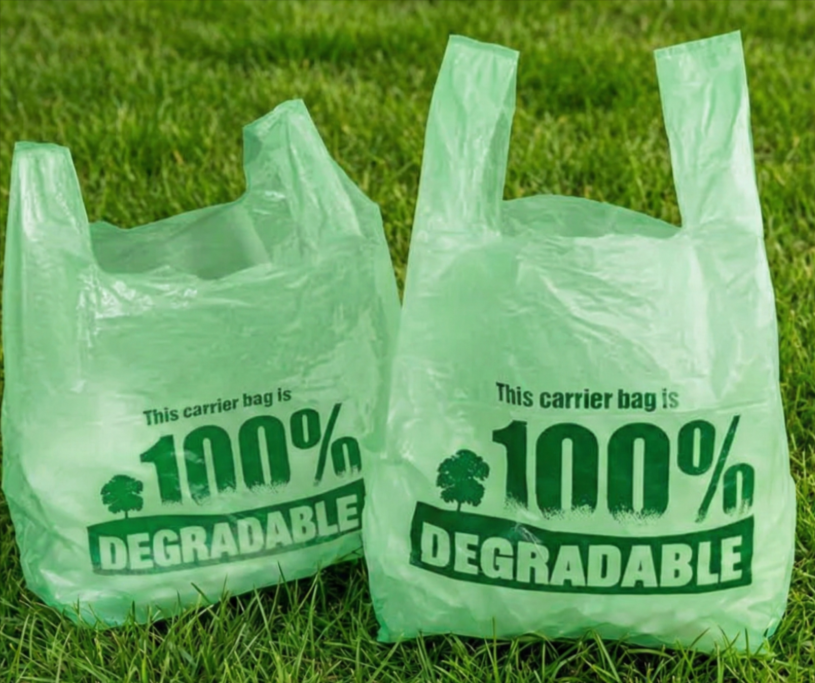
Key Takeaways:
- For bulk B2B purchases a fair price point for a standard biodegradable bag (CPCB/ISO 17088 certified, 13×16″–19×21″) is ₹100 – 180/kilo.
- Retail, specialty, or highly customized bags will cost more, but with added value e.g. printing, color, branding, thickness.
Want to see where Murth fits in this spectrum?
Our EcoGran™ bioplastic bags, for the same 13×16″ size, are routinely quoted at ₹1.05 – 1.66 per piece. It is not just competitive, but often lower than the market median.
This brings us to the most common and surprising question: How can a compostable bag actually cost less than plastic?
Let’s dig into why this is possible and what it means for your bottom line.
Why Are Biodegradable Bags Sometimes Cheaper Than Plastic?
The price of biodegradable plastic bags isn’t always higher. In fact, if you buy from Murth, going green can save you money.
Here’s why this is possible:
Raw materials
- Murth uses agri-waste (hemp, nettle, flax) that’s sourced locally.
- No petroleum imports, no global crude price shocks.
Direct supply chains
- When you buy from a producer like Murth, you skip the multi-layer markup.
- Most “premium” plastic bags add cost at every step: from resin supplier, to manufacturer, to distributor, to retailer.
- Bioplastics, especially when scaled, often come straight from the processor to your facility.
Compliance and hidden costs
- Plastic comes with a different kind of bill. There are non-compliance penalties. Besides there are Plastic Waste Management rules that penalize “non-compostable” plastic at every level.
- A ₹2 “cheap” plastic bag can become a ₹10 headache after fines, lost tenders, and failed audits.
Example
- Suppose you’re handing out 1,000 carry bags/month.
- Old logic: Green costs more.
- Reality:
- Plastic bags (13×16″) at ₹4.61/piece = ₹4,610/month
- Murth bioplastic at ₹1.05 – 1.66/piece = ₹1,050 – 1,660/month
- Direct savings: ₹3,000+ every single month.
Reputation and future-proofing
- Big buyers, especially exporters, malls, and modern retail now demand CPCB-compliant, compostable bags.
- “Going cheap” on plastic isn’t just risky, it’s outdated.
The big takeaway
The myth of “eco-premium” pricing is finished. In 2026 buying biodegradable plastic bags price is the better financial decision, not just the greener one.
So what really decides how much a biodegradable bag will cost you?
Let’s unpack the true cost drivers.
What Factors Affect the Price of Biodegradable Bags?
No two biodegradable plastic bags are priced the same. To make a sound buying decision, you need to know why prices move the way they do.
Here are the key variables:
Raw material costs
- PLA, PBAT, cornstarch, and now hemp/natural-fiber blends (like Murth).
- Raw bioplastic granules in India typically range ₹120 – 250/kilo depending on certification and blend.
- Market volatility: Seasonal agri-waste supply keeps costs stable; imported resin-based plastics often spike unpredictably.
Bag thickness, size, and design
- More microns (thicker bags), larger surface area translates to higher cost per bag.
- Branding, logo, colored printing, and specialty designs add incremental charges.
Certification and compliance
- Only CPCB and IS/ISO 17088-certified bags are legal for most uses.
- Certification is not just a stamp. There is a real cost to testing, registration, batch marking.
- Example: Certified suppliers like BioBaggy or Jezdec often price 10–15% above uncertified, but with full regulatory cover.
Manufacturing scale and plant cost
- Setting up a biodegradable plastic bags manufacturing plant in India costs from ₹40 lakh to ₹2 crore for a typical semi-automatic/automatic line.
- Higher production volumes lower per-bag cost.
Bag making machines
- Automatic lines cost ₹10 – 40 lakh depending on speed and output.
- Local machines compatible with EcoGran™ allow easy switching without new capital outlay.
MOQ and order size
- Most wholesale prices are for large orders of 50 – 100 kilos. The more you buy, the lower the price. Retail buyers have to pay a premium for smaller packs and convenience.
To sum it up,
Your price is shaped by what you buy, how much, and whether you’re demanding full legal compliance.
Buyers focused on the “cheapest” price alone often end up paying much more in penalties and lost business.
Where to Buy Biodegradable Plastic Bags Wholesale in India?
Finding the right supplier for biodegradable plastic bags wholesale is easier than ever, but quality and compliance vary widely.
Here’s how I recommend you approach the market:
Direct from manufacturers
Examples: Murth, Dr. Ecobiopack, Jezdec, BioBaggy, Yuvika, Navkar Plastic.
You get better rates, clearer specs, and access to certifications.
B2B platforms
IndiaMART, TradeIndia, ExportersIndia list dozens of certified suppliers with transparent price bands. Typical MOQ is 50 – 100 kilo.
Industry aggregators and direct contact
There exist supplier directories from CPCB, FIEO, and industry bodies (CII, FICCI). Always check the latest CPCB-certified list to confirm real compliance.
Is Switching to Biodegradable Bags Cost-Effective in 2026?
The biodegradable plastic bags price is no longer a barrier in the Indian market. The prices have reduced substantially. For standard bag sizes, wholesale rates are in the ₹100 – 180/kilo range. This translates to a per bag cost between ₹2 – 10 depending on the customization.
When you add lower GST rates, compliance penalties and brand image the cost is justified and economical. If you want to test the numbers yourself, order a sample kit from Murth today and see the difference firsthand.
Frequently Asked Questions
What is the price of biodegradable plastic bags per kilo in India?
Biodegradable plastic bags cost between ₹100 and ₹200 per kilo. B2B platforms commonly quote prices around ₹130 – ₹180/kilo.
Are biodegradable plastic bags expensive compared to regular plastic?
That used to be true at one time but not any more. The use of agricultural waste as raw materials and lower GST rates have reduced prices and made them cheaper.
What is the biodegradable plastic bags GST rate in India?
There is good news on this front. The GST is now down to 5% from earlier 18%. This has helped reduce prices across the board.
Where can I buy biodegradable plastic bags wholesale in India?
You can buy directly from reputed manufacturers like Murth. It is also possible to order from IndiaMART and TradeIndia.
What certifications should I look for when buying biodegradable bags in India?
Always look for:
- CPCB Approval – a valid certification number must be displayed.
- IS/ISO 17088 – every batch must be tested by a reputed lab.
- Batch Number – each bag must have a scannable QR code and batch number.