

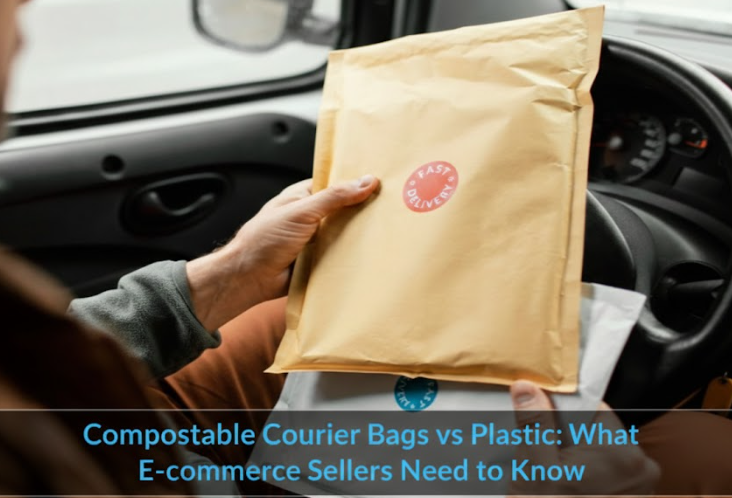
Compostable Courier Bags vs Plastic: What E-commerce Sellers Need to Know
E-commerce packaging has been changing for some time now.
Compostable courier bags are now everywhere including major fashion retailers and local grocery deliveries.
Plastic courier bags were once celebrated for their low cost and durability. But such single-use plastic items are facing rising global bans, mounting taxes, and growing scrutiny from consumers.
About 161 billion parcels were shipped worldwide in 2025 (Pitney Bowes), and most were wrapped in single-use plastic.
So what’s the alternative? Compostable courier bags compete with plastic ones for e-commerce sellers on three fronts.
Plastic vs Biodegradable courier bags: Do global regulations change the equation?
The shift from plastic courier bags to compostable alternatives is more than a passing trend.
The regulations are reshaping the market:
In the EU, new Packaging & Packaging Waste Regulation (PPWR) drafts mean that lightweight plastic bags will soon be banned unless they’re certified compostable and collected with organic waste.
India’s updated Plastic Waste Management Rules require companies to collect and process 100% of all compostable packaging.
In the US state of California, landmark law SB 54 will require all packaging to be recyclable or compostable by 2032.
Plastic packaging is also taxed.
In the UK, the Plastic Packaging Tax rises to £250 per tonne in April 2026. Across the EU, an Own-Resources Levy adds €180 per tonne for non-recycled plastic packaging.
India’s EPR regime can also add fees of up to ₹6 per kilogram for non-compliant packaging.
And don’t forget reputation. Giants like Amazon, H&M, and Flipkart have all pledged to use 100% recyclable or compostable packaging by 2027.
ESG investment criteria now flag virgin plastic intensity as a material risk. This means that brands slow to adapt could see their access to capital shrink.
Consumer demand is also shifting. Gen Z and Millennials might also be willing to pay more for packaging that is eco-friendly (Deloitte Sustainable Packaging Survey).
So, the business case for compostable courier bags vs plastic is strong for three reasons. First, regulations, second, consumer preference and third environmental protection.
Some environmental benefits that compostable courier bags offer over plastic one are:
Greenhouse gas emissions: LDPE plastic emits about 2.6 kg CO₂e per kg, while PLA/PBAT compostables are closer to 1.5 kg.
Microplastics: Certified compostables leave minimal residue, while plastic fragments persist indefinitely.
But what are these new materials, and how do they really compare to plastic?

When you think of compostable courier bags, you might picture plain paper, or cornstarch-based film.
But compostable courier bags are made from many types of innovative materials.
Which compostable courier bag materials are on the market?
Today, compostable courier bags come in multiple forms, including poly mailers and eco-friendly courier bags. Understanding your options is the first step to making a smart switch. Let’s break down the main contenders:
Paper Kraft Mailers
Made from renewable paper, they are easy to brand and both recyclable and home compostable.
Downsides? Lower tear strength and higher weight than plastic, which means higher shipping costs and less durability in wet weather.
Paper Plus Compostable Coating (PLA or water-based)
These paper courier bags are reinforced with a thin, compostable layer. This makes them water resistant yet still recyclable and compostable.
PLA/Pbat Film Mailers
A serious challenger to plastic courier bags is a bioplastic compostable courier bag. Flexible and opaque, these mailers mimic plastic’s feel and can pass drop tests with flying colors.
Compostable bio plastic courier bags, that break down safely and completely under composting conditions, are another responsible and practical replacement for traditional plastic .
Cellulosic Film Mailers
Cellulosic film mailers are made from wood pulp. They offer high oxygen and moisture barriers and can be certified home compostable by standards like TÜV OK Home Compost.
Next, let’s see how these bags hold up in e-commerce shipping.
Do compostable mailers match plastic performance in shipping?
Performance matters because packaging needs to do more than just look good on paper.
Modern PLA/PBAT mailers now pass tough shipping tests:
They survive the Amazon SIOC drop test (36 inches, three faces) with less than 0.25-inch tears.
Seal strength and print quality are up there too. Thermal-transfer barcodes scan 99.6% of the time on coated paper and PLA film.
What about moisture?
PLA/PBAT films have a water vapor transmission rate (WVTR) of about 8 g/m²·day at 38°C and 90% humidity. LDPE plastic scores slightly better at 6 g. But both are suitable for clothing and many dry goods.
For food or powders, you may need an extra liner.
How long do they last?
PLA/PBAT mailers retain 90% of their strength after nine months at room temperature and moderate humidity. LDPE lasts longer, but for most retail cycles, that’s plenty.
So, eco-friendly courier bags don’t mean you have to compromise on delivery quality.
What rules and collection systems shape end-of-life?
It is not enough for a mailer to be “green,” it needs a clear, workable end-of-life pathway.
Policy quirks to watch:
The UK’s Plastic Packaging Tax doesn’t exempt compostables, but EPR fees can be reduced for certified bags.
The EU’s new PPWR allows compostables for specific “demonstrably beneficial” uses flexible bags under 20 microns, for example.
California’s AB 1201 may ban PLA films from “organics” collection unless facilities prove they can break down.
So, always source compostable bags with proper certification. In Europe, the gold standard is EN 13432; in the US, it’s ASTM D6400; India uses IS 17088.
Now, let’s talk costs and how the numbers are changing as the market evolves.
Compostable Courier Bags vs Plastic: Pricing comparisons

There is a deeply entrenched belief in packaging that eco automatically means expensive.
That belief usually comes from comparing the wrong products in the wrong way.
If you look at real, high volume use cases and not niche prototypes, the numbers tell a very different story.
Murth’s high tensile strength compostable courier bags made from agro-waste are just as competitive as plastic ones. Our compostable carry bag (13” × 16”) cost about ₹1.05-₹1.66 (US$ 0.012) per piece.
So, is investing in compostable courier bags a smart bet?
More than 95 countries now have plastic bans or taxes, and 92% of the world’s GDP is covered by net zero pledges.
For e-commerce sellers using more than 1,000 bags a month, switching to compostable courier bags like our’s at Murth is not a sustainability premium. It is a practical compliance and brand advantage with zero change to operations.
Start by auditing your current courier bag usage and model for new taxes and EPR incentives. Then, pilot a compostable solution like our eco-friendly courier bag range before your next big procurement.